
AP Language and Composition: How to Build a Strong Synthesis Essay
The synthesis essay is one of the most practical writing tasks on the AP Language and Composition exam because it asks you to do something writers do constantly: read a set of sources, understand the conversation around an issue, and build your own argument from that conversation.
It is not a summary task. It is not a “use every source” task. It is not a scavenger hunt for quotations. A strong synthesis essay uses sources as evidence in service of a clear, defensible argument. Your job is to enter the debate, decide what you think, and use the sources strategically to prove it.
What the synthesis essay asks you to do
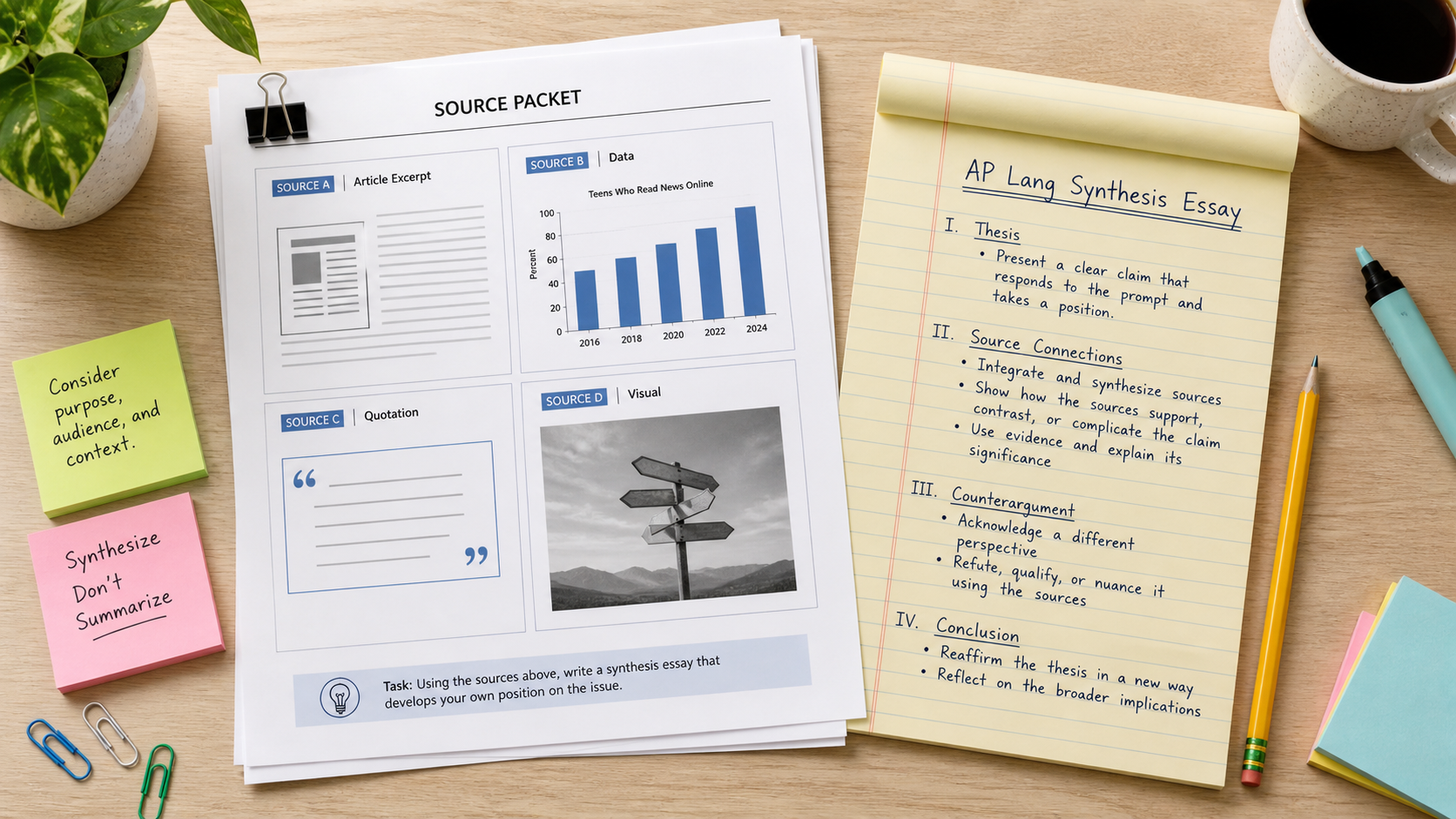
For this essay, you will receive a prompt and a packet of sources. The sources may include articles, charts, images, excerpts, or data sets. You will need to read them quickly, identify the major positions and tensions, and write an argument that uses at least three of the sources.
The keyword is argument. The College Board is not asking whether you understood each source in isolation; it is asking whether you can use source material to develop your own line of reasoning. That means your thesis must take a position, your paragraphs must build that position step by step, and your sources must be integrated as evidence rather than dropped into the essay.
A weak synthesis essay sounds like this: “Source A says this. Source B says that. Source C also says something similar.” A strong synthesis essay sounds like this: “Although X is a valid concern, the best approach is Y because it addresses the root problem while avoiding Z.” The difference is ownership.
Start by finding the conversation
Before you write, map the sources into a conversation. Ask yourself: Who seems to agree? Who disagrees? Which source gives data? Which source offers a personal or ethical perspective? Which source complicates the issue?
You are looking for relationships between sources. Maybe two sources support the same general position but for different reasons. Maybe one source provides a useful counterargument. Maybe a visual source reveals a trend that an opinion piece ignores. This is where synthesis begins: not in quoting sources, but in understanding how they speak to one another.
A helpful planning move is to sort sources into three categories: sources that support your likely position, sources that challenge it, and sources that complicate it. The strongest essays usually use all three. They prove a claim, acknowledge a real concern, and then explain why the argument still holds.
Build a thesis with direction
Your thesis should do more than answer yes or no. It should create a path for the essay.
Instead of writing, “Schools should use technology in classrooms,” try something more precise: “Schools should integrate classroom technology selectively because digital tools expand access to information and feedback, but only when paired with clear limits that protect attention and discussion.”
This thesis has a position, a reason, and a qualification. It gives you somewhere to go. You can now write one paragraph on access, one on feedback or efficiency, and one that addresses the need for limits. That last move is especially important because synthesis prompts usually involve complex public issues. A thesis that admits complexity often becomes easier to defend than one that pretends the issue is simple.
Use sources as support, not substitutes for thinking
The most common synthesis problem is source dumping. Students quote or paraphrase a source, then move on without explaining how it proves the argument. Evidence does not speak for itself. You have to interpret it.
A strong paragraph follows a clear rhythm: make a claim, introduce the source, explain the evidence, and connect it back to your reasoning. If a source provides data, explain what the trend suggests. If a source gives an expert opinion, explain why that perspective matters. If a source disagrees with you, use it honestly, then show the limit of its objection.
For example:
Source C’s chart shows that students who receive immediate feedback revise more frequently than students who wait several days. This matters because the value of technology is not the screen itself, but the speed of the learning loop it can create. When digital tools shorten the distance between mistake and correction, they support the kind of revision that traditional instruction often struggles to provide quickly.
Notice that the source is doing a job. It is not simply included because the rubric requires it.
Make the sources interact
Synthesis means connection. The best essays do not place sources in separate boxes. They bring them into contact.
You might write: “While Source A emphasizes the efficiency of automated feedback, Source D reminds us that speed is not the same as understanding.” That sentence does two things at once: it shows you understand both sources and it creates space for your own argument. You might then argue that technology is most useful when it accelerates routine feedback but does not replace teacher-led discussion.
This is the difference between using sources and synthesizing them. Using sources means citing them. Synthesizing means arranging them into a larger argument.
Do not fear the counterargument
A counterargument is not a threat to your essay; it is an opportunity to show control. If a source challenges your position, use it. Acknowledge what it gets right, then explain where it falls short.
For instance, if one source argues that technology distracts students, you might concede that unrestricted device use damages attention. But you can then argue that this is a reason for structured integration, not total rejection. The move is simple: concede the valid concern, define its limit, and return to your claim.
That kind of reasoning can help your essay feel mature. It shows that your position has survived contact with opposing evidence.
Write with clarity and control
Because the synthesis essay involves multiple sources, organization matters. Your reader should never wonder why a source appears in a paragraph. Topic sentences should name the idea, not the source. Transitions should show logical movement: however, therefore, by contrast, for this reason.
Avoid beginning every paragraph with “Source A says…” or “In Source B….” That structure lets the sources control the essay. Instead, begin with your claim and bring in the source when it becomes useful.
A better pattern is: “One reason selective technology use matters is that it can improve access to timely feedback.” Then introduce the source as support. Your idea leads; the source follows.
A practical exam plan
Spend the first few minutes reading the prompt carefully and deciding what the issue is really asking. Then skim the sources for position, evidence type, and usefulness. Mark three or four sources you know you can use well. You only need at least three, so do not force every source into the essay.
After that, draft a thesis and plan two or three body paragraphs. Each paragraph should have a job: one reason, one part of the argument, or one complication. Then write to develop your reasoning, not merely meeting the citation requirement.
A simple structure works well:
Introduction with a defensible thesis.
Body paragraph one: first reason, supported by one or two sources.
Body paragraph two: second reason, supported by one or two sources.
Body paragraph three: counterargument, qualification, or broader implication.
Conclusion that sharpens the argument rather than repeating it.
Final reminder
A strong synthesis essay proves that you can think with sources, not hide behind them. Read the packet as a conversation, decide where you stand, and use the sources to build a case that is clear, specific, and fair.
The goal is not to sound like every source at once. The goal is to sound like a writer who has listened carefully, judged thoughtfully, and now has something worth arguing.