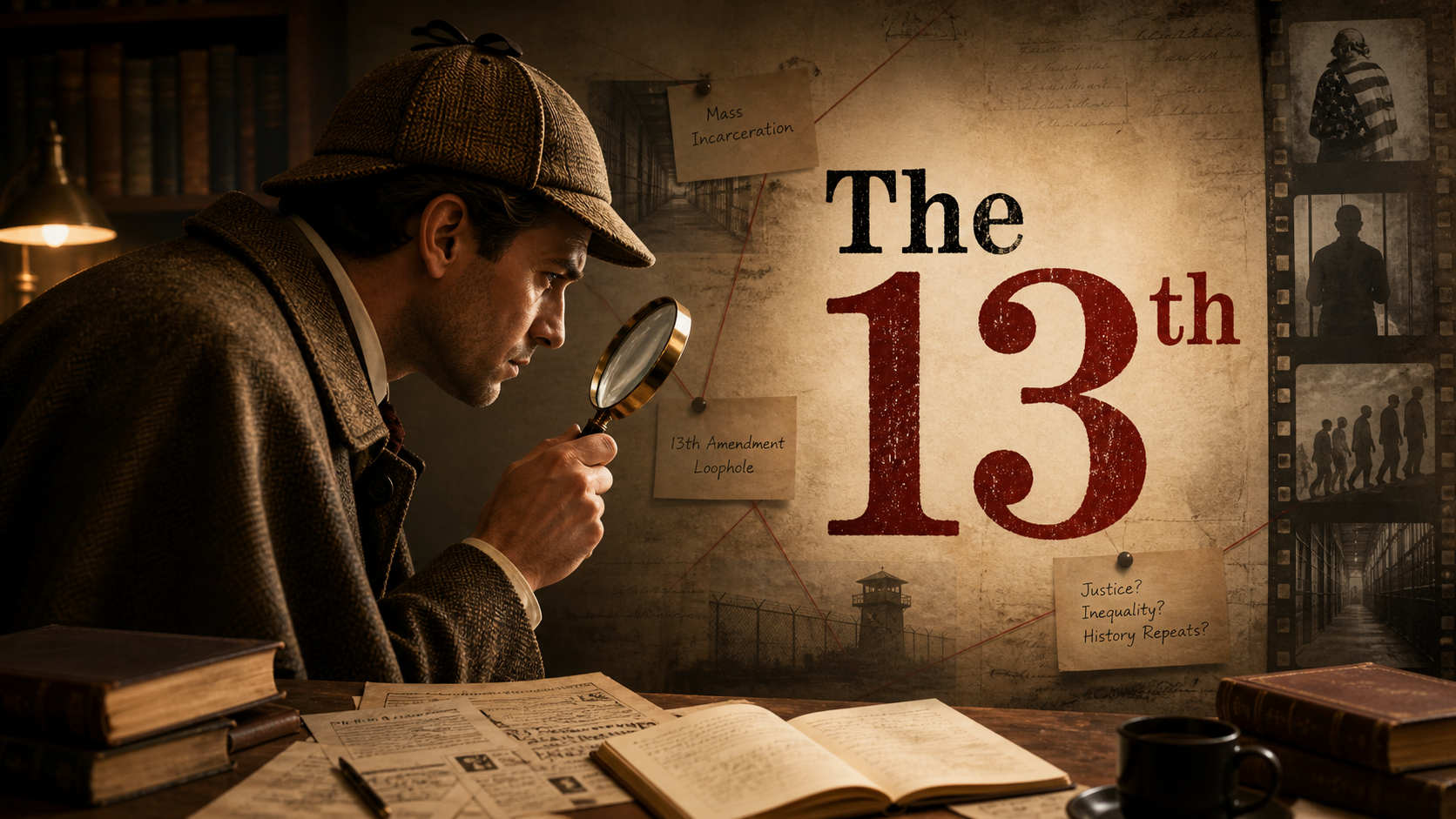
Learning to Read Documentaries Ethically: DP1 Students Audit The 13th
Why documentaries deserve close reading
Documentaries often feel like truth. They show interviews, statistics, archival footage, expert voices, headlines, dates, and real events. That makes them powerful. It also makes them worth studying carefully.
In IB English A: Language and Literature, students learn that documentaries do not simply present information. Filmmakers construct them. Every cut, camera angle, sound cue, statistic, interview choice, and omission shapes how viewers respond.
This semester, our DP1 English A: Language and Literature students explored that idea through an Ethical Audit of Ava DuVernay’s documentary The 13th. The task asked students to choose three distinct moments from different sections of the documentary. Each moment needed to last between 60 and 180 seconds, and students had to include exact timestamps.
Looking beyond summary
The project challenged students to move beyond plot summary. Instead of asking, “What happened?” students asked, “What claim does this moment make, and how does the film make that claim convincing?”
For each selected moment, students identified the claim the film advanced. They also noted who spoke or what source appeared on screen. This might include an expert, a politician, an activist, an archival clip, a headline, or a statistic.
From there, students studied how the documentary constructed authority. The students looked at who received speaking time and who did not. They examined framing, including close-ups, wide shots, camera angles, lighting, and background: editing, sound, and on-screen text were also analyzed.
These choices matter. A close-up can create intimacy or urgency. A sudden cut can create contrast. Music can intensify emotion. A statistic can make an argument feel objective. A headline can anchor a moment in public memory.
Asking ethical questions
The task also asked students to think ethically. A documentary can make a strong argument and still require careful questioning. Students considered what context the film provided. They also looked for context that the film compressed, skipped, or left unclear.
This part of the audit pushed students to ask difficult questions. Does the film present a counterview? Is one implied? Was it excluded? What does the viewer need to judge the claim fairly?
These questions helped students become more responsible viewers. They did not simply accept or reject the film’s argument. They examined how evidence, structure, and selection shaped that argument.
Tracking audience effect
The final stage of the audit focused on audience response. Students considered what the viewer might feel, assume, or question during each moment. They also examined how the film positioned viewers to judge people, institutions, policies, or historical events.
This skill sits at the heart of Language and Literature. Students must connect authorial choices to audience effect. In a documentary, that means asking how image, sound, sequencing, and evidence guide interpretation.
For example, rapid editing can create urgency. Silence after a statistic can give the claim more weight. Placing two interviews side by side can create contrast or irony. These are not accidental effects. They are part of the film’s design.
Why this matters for IB English
The most important rule of the task was clear: “Don’t write a plot summary. Write observable choices + effects.”
That rule captures one of the most important habits in IB English. Summary tells us what a text says. Analysis explains how the text creates meaning.
By focusing on observable choices, students practiced the same thinking they need for Paper 1, the Individual Oral, and future analytical writing. They treated film as a crafted text, not just as content to watch.
Connecting documentary, justice, and media literacy
This project also connected to our wider BLM unit. The 13th gave students a complex non-literary text through which to examine race, justice, representation, and power. At the same time, the Ethical Audit asked them to evaluate method, context, and fairness.
That balance matters. Students learned to respond to urgent social issues with both empathy and analytical discipline. They could recognize the importance of the documentary’s message while still asking how the film built its argument.
Building responsible viewers
By the end of the project, students had practiced a sophisticated form of critical viewing. They paused the film, isolated a claim, identified sources, studied authority, checked context, and explained audience positioning.
These are not only IB skills. They are civic skills.
We live in a world full of video clips, headlines, statistics, interviews, and persuasive storytelling. Students need to know how to ask better questions of the media they encounter. They need to ask who speaks, what evidence appears, what context is missing, and how the text asks them to feel.
Final reflection
The 13th asks viewers to confront difficult histories and ongoing systems of injustice. Our Ethical Audit asked students to confront a related question: how do powerful texts persuade?
Through this project, DP1 students learned that responsible viewing requires more than attention. It requires evidence, fairness, and a willingness to slow down. It means looking closely at the choices behind the message.
That is what strong Language and Literature students do. They do not only watch. They investigate.