
From Theory to Reality: How a School Marketing Challenge Teaches Strategy
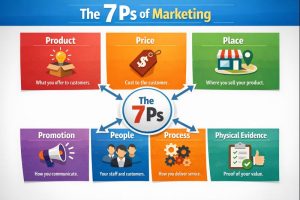
Every year, students learn the 7 Ps of marketing. Every year, many of them forget them just as quickly. Not because the framework is outdated, but because it’s often taught in isolation, as a checklist of concepts rather than a living, strategic tool. Real marketing isn’t about memorizing labels; it’s about making decisions that exclude other options, align with a coherent strategy, and hold up under scrutiny. If students never experience the tension between competing priorities, they aren’t learning marketing, they’re learning vocabulary.
That’s why service organizations, particularly schools, are such powerful teaching tools. Unlike consumer products, education is intangible, long-term, and trust driven. Parents don’t buy education the way they buy trainers or smartphones; they invest in an experience, outcomes, and values that may only become visible years later. Marketing a school exposes the fragile threads that hold a strategy together and makes students confront the real-world consequences of every decision.
The 7 Ps, Properly Understood
For service-based organizations, the traditional marketing mix expands beyond just product and price to include seven interdependent elements: Product, Price, Promotion, Place, People, Process, and Physical Evidence. At first glance, the 7 Ps seem neat and manageable, an organized framework to structure ideas. In practice, each element interacts with the others, sending signals that can either build trust or undermine it. Adjust one element without considering the rest, and the strategy collapses. For schools, where credibility and reassurance matter more than advertising flair, the framework is unforgiving.
Why a School Is a Brutally Honest Marketing Test
Business Management students are experiencing this firsthand as they develop full marketing plans for the English International School of Bratislava (EISB). Their challenge is to apply the 7 Ps strategically, aligning every element to position EISB competitively within the international education market. What seems like a structured exercise quickly becomes a high-stakes test of decision-making. You can’t claim academic excellence if your People strategy doesn’t reflect it. You can’t justify Price levels if your Process is inefficient or confusing. You can’t promote community if your Physical Evidence, the appearance of classrooms, facilities, and the campus, feels transactional.
The exercise is revealing because it forces students to confront uncomfortable realities. Decisions in isolation may seem harmless, but when combined, they either form a coherent strategy or expose weak thinking. Schools are especially unforgiving: in the real world, every mismatch between expectation and delivery risks trust, which is the core product in education.
From Framework to Friction
As students develop their strategies for EISB, the learning comes not from ticking boxes, but from experiencing tension. Raising fees forces critical conversations about value. Expanding the curriculum generates questions about staffing, teacher training, and resource allocation. Amplifying promotion increases expectations that admissions, communication, and student support processes can deliver. Every change has ripple effects. Inconsistency stops being a minor flaw and becomes a strategic failure. It is here that the 7 Ps truly fulfill their purpose: they don’t make decisions for you, but they expose the consequences of weak or disconnected ones.
The Hidden Power of the “Soft” Ps
Perhaps the most surprising lesson for students is how quickly their focus shifts from promotion to the so-called “soft” Ps. In service marketing, the people delivering the service, the process by which it is delivered, and the tangible evidence of quality often outweigh even the flashiest advertising. For EISB, one ineffective teacher can undermine the school’s reputation. Clunky admissions processes can destroy parent confidence before a child even starts. And the campus environment communicates more about quality than any brochure ever could. Students reach these insights not because they are told to, but because weaker strategies fail under scrutiny, while coherent strategies hold together.
Strategy Is Coherence, Not Creativity
When multiple teams develop marketing plans for the same school, it becomes immediately clear that creativity alone does not define success. The strongest strategies are those where every element of the marketing mix reinforces the same positioning, values, and target audience. It is not the flashiest or most imaginative idea that wins, it is the idea that is consistent, coherent, and defensible. Students see in real time how alignment builds credibility and trust, and how misalignment destroys it. This lesson is far more valuable than memorizing definitions: strategy is not about creativity for its own sake; it is about coherent decision-making that holds up under pressure.
What This Really Teaches
At its core, this approach teaches that marketing is not persuasion, it is alignment. It trains students to justify decisions, evaluate trade-offs, recognize constraints, and think like strategists rather than students chasing “the right answer.” By applying the 7 Ps to a real school like EISB, students confront tangible, high-stakes challenges that mirror real organizational dilemmas. The framework doesn’t create strong strategies; it reveals whether strong thinking is present. And when every decision has consequences, there is nowhere for weak strategies to hide.
The lesson is simple but profound: frameworks don’t make marketers. Thoughtful, aligned, and accountable decision-making does.