Enabling Amazing: Learning Anatomy at Age Six, a Multi-Level Learning Experience
At EISB, we often talk about Enabling Amazing. Sometimes that phrase sounds like a slogan. Sometimes it sounds like an aspiration. And then there are moments when you walk into a classroom and see exactly what it means.
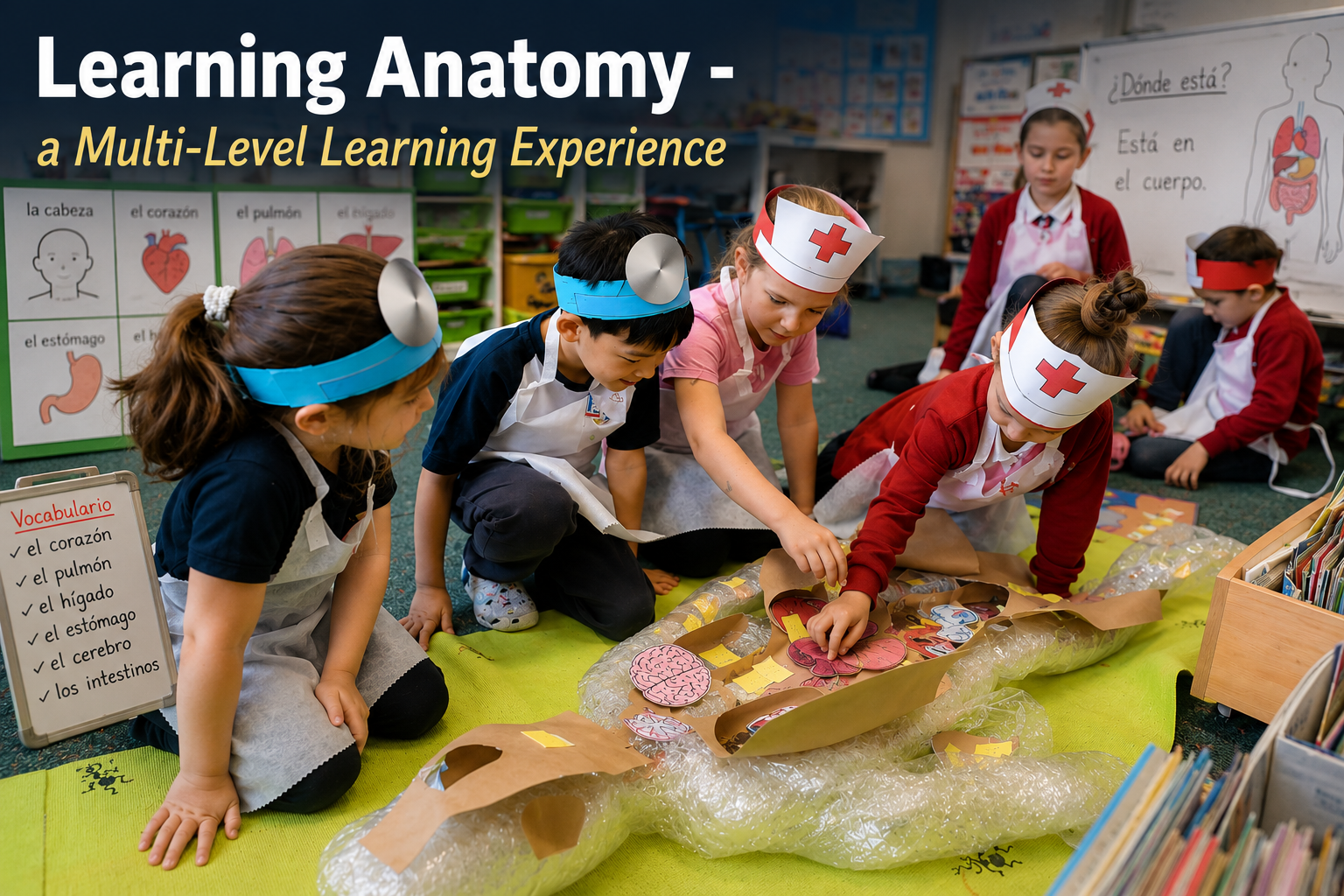
This week, I had the opportunity to join Ms. Eva’s (Gogova) Year 2 Spanish lesson that students proudly referred to as an “Autopsy.”
Before anyone worries, no actual patients were involved.
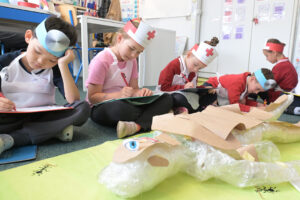
Instead, six-year-old students transformed their classroom into a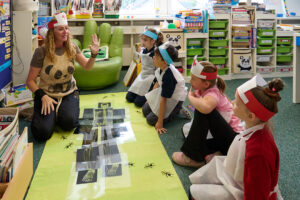 hands-on medical laboratory. Dressed as doctors and nurses, they explored the human body by identifying internal and external body parts, placing organs where they belong, discussing their functions, and connecting each piece to a larger understanding of how the body works.
More Than Memorization
What made the lesson remarkable was not simply that students could name body parts.
They could:
- Identify organs and body structures when shown visually.
- Explain where those organs belong.
- Place them correctly within a model body cavity.
- Connect body parts to their functions.
- Work collaboratively to solve problems and explain their thinking.
This wasn’t a worksheet exercise. It was active learning, inquiry, communication, collaboration, and critical thinking happening simultaneously.
The students weren’t just learning about the human body.
They were learning how to learn.
That distinction is important.
At EISB, our focus extends beyond content knowledge. We want students to develop the skills to think, reason, communicate, and apply knowledge in meaningful ways. These performance outcomes sit at the heart of our educational philosophy.
The Part That Makes It Extraordinary
There is another detail that makes this lesson especially impressive.
The entire lesson was conducted in Spanish.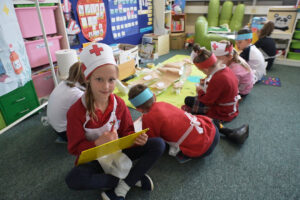
For many schools, anatomy and internal organs are topics introduced much later in the curriculum. In many English-language programmes, detailed study of internal body systems does not begin until Years 4 or 5.
Yet here were six-year-olds learning concepts years ahead of schedule.
And they were doing it in their third language.
Think about that for a moment.
A child may speak Slovak at home. Learn in English throughout the school day. Then enter Spanish class and successfully discuss anatomy, body systems, and organ placement entirely in Spanish.
That level of language development doesn’t happen by accident.
It happens because language at EISB is not treated as a separate subject. It is treated as a tool for thinking, exploring, and understanding the world.
Why Young Children Can Do More Than We Think
One of the greatest misconceptions in education is that young children need everything simplified.
In reality, young learners are incredibly capable when learning is hands-on, meaningful, and connected to their natural curiosity.
The Year 2 students were not memorizing vocabulary lists.
They were engaged in role play.
They were handling physical models.
They were discussing ideas with classmates.
They were making mistakes, testing ideas, and correcting their understanding.
This kind of active, inquiry-based learning aligns closely with both EISB’s educational philosophy and the principles of high-quality international education, where authentic experiences drive deeper understanding.
A Perfect Example of Multiple-Level Learning
One of the principles discussed in Teaching Towards Tomorrow is that effective learning occurs on multiple levels simultaneously. Students are not simply acquiring content; they are developing skills, habits, language, confidence, and understanding at the same time.
This lesson demonstrated exactly that.
Students were learning:
Science
- Human anatomy
- Body systems
- Organ functions
Language
- Spanish vocabulary
- Listening comprehension
- Speaking confidence
- Academic language
Thinking Skills
- Classification
- Problem-solving
- Spatial reasoning
Social Skills
- Collaboration
- Communication
- Shared decision-making
Personal Development
- Confidence
- Curiosity
- Risk-taking
- Independence
One lesson.
Multiple levels of learning.
Multiple outcomes.
That is how deep learning happens.
Building Multilingual Learners
At EISB, our language goals are ambitious because we know children are capable of achieving them.
By the time many of our students complete Primary School, they are functioning confidently in three languages, and in some cases four.
This multilingual development is not achieved through endless grammar drills or memorization exercises.
It comes from using language authentically.
Students learn languages by solving problems, conducting investigations, presenting ideas, creating projects, performing, collaborating, and engaging with meaningful content.
The Year 2 Autopsy lesson was a perfect example.
The students were not learning Spanish so they could someday use it.
They were already using it.
What Parents Should Look For
When parents visit schools, it is easy to focus on facilities, technology, or examination results.
Those things matter.
But some of the most important indicators of quality education are found inside everyday classroom experiences.
Ask yourself:
- Are students actively engaged?
- Are they thinking rather than simply repeating?
- Are they applying knowledge in meaningful ways?
- Are they communicating confidently?
- Are they learning skills that transfer beyond the classroom?
- Are they excited about learning?
Watching six-year-olds discuss anatomy in Spanish while collaboratively building a model of the human body provided a clear answer to all of those questions.
Enabling Amazing
The lesson lasted less than an hour.
Its impact will last much longer.
It demonstrated what happens when high expectations meet engaging teaching. It showed what young children can achieve when given meaningful challenges. Most importantly, it revealed what is possible when a school focuses not just on what students know, but on what they can do with what they know.
Six-year-olds learning anatomy.
In Spanish.
Two years ahead of the traditional curriculum.
Confidently, collaboratively, and enthusiastically.
That is not just good teaching.
That is EISB.
That is Enabling Amazing.