
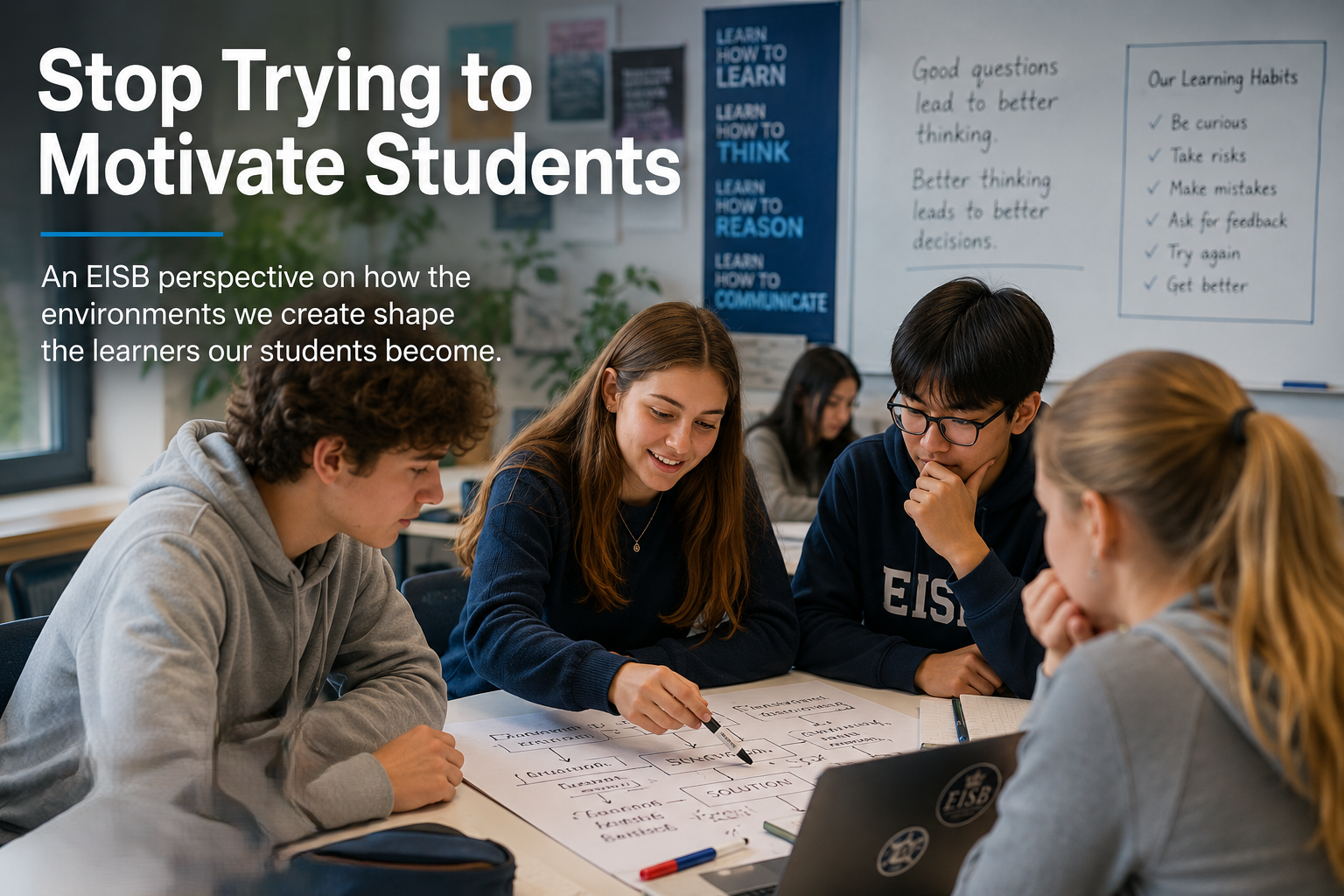
Stop Trying to Motivate Students (?)
An EISB perspective on how the environments we create shape the learners our students become.
Schools spend a remarkable amount of time trying to motivate students.
We try to motivate them to read more, work harder, participate, think deeply, complete assignments, take responsibility and care about their learning.
And when those behaviours do not appear, motivation often becomes the diagnosis:
They just don’t care enough.
Sometimes that may be true.
But before asking what is wrong with the student, there is another question worth asking:
What has the student learned from the environment around them?
Students Learn More Than We Teach
Every school has a curriculum.
But students are also learning from something less visible: the repeated experience of being at school.
Imagine that we say we want students to become independent learners.
But then we tell them what to do, when to do it, how to do it, what resources to use, what the answer should look like and what to do the moment they become stuck.
Eventually, students learn to wait.
Then we become frustrated because they lack independence.
Or imagine that we tell students mistakes are an important part of learning.
But the student who answers incorrectly experiences embarrassment, loses marks or watches the teacher immediately turn to someone who knows the answer.
Students quickly learn a different lesson:
Mistakes may be useful for learning, but being wrong is still dangerous.
Or perhaps we say we want students to think critically, while most of the questions they encounter require them to remember something the teacher already knows.
Again, students adapt.
They learn that school is less about thinking than figuring out what answer the adult wants.
None of these lessons necessarily appear in a curriculum document.
But students learn them anyway.
Because the environment is always teaching.
What Are Students Practising?
At EISB, we talk about four enduring Performance Outcomes:
Learning How to Learn.
Learning How to Think.
Learning How to Reason.
Learning How to Communicate.
Content gives students something meaningful to learn, think, reason and communicate about.
But skills do not develop because we tell students they are important.
They develop through practice.
A student cannot become an independent learner without experiencing independence.
A student cannot become a better thinker without having to think.
A student cannot learn to reason if every difficult decision has already been made.
A student cannot become an effective communicator by spending most of the school day listening.
This creates a useful shift in lesson planning.
Instead of only asking: What am I teaching today?
we can also ask: What will students practise becoming today?
That question changes things.
Independence Requires Something to Be Independent About
If we want students to learn how to learn, they need meaningful decisions to make.
Which resource should I use?
What question should I investigate?
What should I try when my first strategy fails?
How do I know whether I understand this?
What do I need to do next?
If adults make every one of those decisions, students may complete the assignment successfully while practising very little independence.
Sometimes the most educationally valuable thing a teacher can do is resist solving a problem too quickly.
Not because struggle is automatically good.
But because a manageable difficulty creates an opportunity for students to practise learning.
The same applies to thinking.
If every question has one predetermined answer, students become very good at searching for predetermined answers.
If we want students to develop judgment, curiosity and critical thinking, they need questions that actually require judgment, curiosity and critical thinking.
The Environment Changes the Meaning of Failure
This matters particularly when students struggle.
We can tell students a hundred times that failure is part of learning.
But what matters more is what happens when failure actually occurs.
Does a wrong answer end the conversation—or begin one?
Does unsuccessful work simply receive a poor result—or does the student use feedback to improve it?
When a group encounters a problem, does the teacher fix it—or ask them what they might try next?
When students disagree, are they looking for the teacher to declare a winner—or learning to examine evidence and reasoning?
Our response to difficulty teaches students what difficulty means.
It can mean: Stop. You aren’t good at this.
Or it can mean: Something here hasn’t worked yet. What can we learn from it?
That difference matters enormously.
Motivation Often Follows Participation
We sometimes assume students must first become motivated and then they will participate.
Often the relationship works in the other direction.
Students participate.
They encounter a challenge.
They make a decision.
They discover something.
They contribute an idea.
They improve.
And through that experience, the learning begins to matter.
This is one reason student-centred learning is not simply about making lessons more enjoyable or giving students unlimited choice.
It is about putting students in a position where their thinking and actions genuinely affect what happens next.
Their questions matter.
Their decisions matter.
Their reasoning matters.
Their contribution matters.
When students experience themselves as active participants in learning rather than recipients of it, we create very different conditions for motivation.
Design the Behaviour Into the Learning
So perhaps the question is not:
How do I motivate my students to become independent learners?
Perhaps it is:
Where in today’s lesson will they actually experience independence?
Instead of: How do I get students to think more critically?
Ask: What decision today requires them to think?
Instead of: How do I get students to communicate better?
Ask: Who needs to hear their thinking, and why?
Instead of: How do I make students more resilient?
Ask: Where will they encounter a difficulty that I will allow them to work through?
These are small changes in the questions we ask as teachers.
But they produce significant changes in what students experience.
What Makes Learning Inevitable?
We cannot guarantee what every student will learn.
Students are individuals. Motivation matters. Relationships matter. Prior knowledge matters. Well-being matters. A hundred variables enter a classroom with our students every morning.
But we can influence what behaviours the environment repeatedly invites.
If students regularly ask questions, they practise inquiry.
If they regularly make meaningful choices, they practise independence.
If they regularly explain why they think something, they practise reasoning.
If they encounter different perspectives, they practise thinking beyond their first response.
If they communicate ideas to real audiences, they practise communication.
If they receive feedback and have opportunities to respond to it, they practise improvement.
And if they encounter manageable difficulty without someone immediately removing it, they begin learning that struggle is something they can navigate.
Eventually these experiences become more than classroom activities.
They become habits.
And habits begin to shape the learner.
Begin With a Better Question
So the next time a student seems unmotivated, dependent or reluctant to think, it may be worth resisting the immediate urge to persuade them to try harder.
Look first at the learning environment.
What are students being asked to do repeatedly?
Where are they making decisions?
Where are they thinking rather than recalling?
What happens when they make a mistake?
Who is doing most of the talking?
Who solves the difficult problems?
What behaviours does success in this classroom actually reward?
Because students are always learning something from school.
The question is whether the environment is helping them practise becoming the learners we hope they will become.
One Question to Carry Forward
What are your students practising becoming in your classroom every day?