
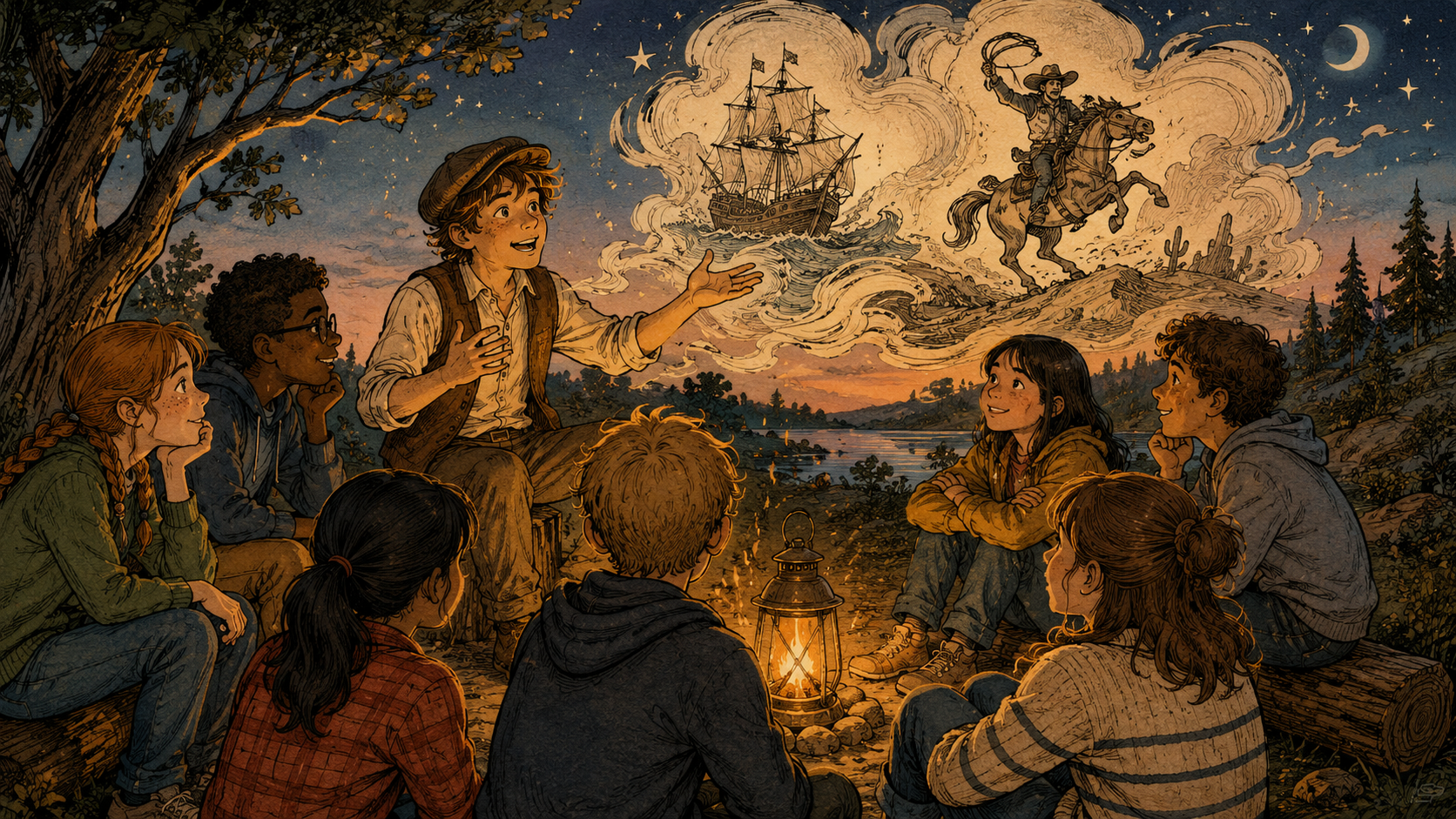
Calling All Storytellers: Tall-Tale-Tellin’ Competition 2025–2026
Do you enjoy telling stories, performing for an audience, or taking a familiar tale and giving it a completely new twist? This year, our school has received an invitation to the 13th annual Tall-Tale-Tellin’ Competition, hosted by Súkromné gymnázium a Súkromná základná škola, Česká 10, Bratislava. The competition will take place on Friday, June 12, with check-in from 07:30–08:00.
This is a great opportunity for students who enjoy English, creative writing, drama, public speaking, improvisation, or simply making an audience laugh, think, or lean in to hear what happens next.
What is the competition?
The Tall-Tale-Tellin’ Competition is a storytelling contest in English. Students compete by preparing and performing stories in front of an audience and judges. It is not just about memorizing a text. It is about voice, creativity, audience connection, confidence, and the ability to shape a story that feels alive.
Competitors are placed into categories based on both age and English level. The younger categories are for students aged 8–13, while the older categories are for students aged 14–19. Students are also grouped by language level, from A1/B1 to B2/C2, so the competition can fairly recognize different kinds of English speakers and learners.
The prepared story
The main task is the long-preparation activity. Each competitor prepares a modern adaptation of a classic children’s story and performs it for the audience. The story must be composed by the competitor after receiving the required parameters. It should be no longer than 500 words and no more than 5 minutes in performance. Competitors must also submit the full text to the judges.
This is where students can really shine. A modern adaptation might take an old fairy tale and move it into a school hallway, a city bus, a football match, a social media argument, or a futuristic Bratislava. The goal is not only to retell a story, but to transform it with imagination, control, and purpose.
Short preparation and improvisation
The competition may also include a short-preparation storytelling task. In this round, competitors receive criteria on the day, have around 15–20 minutes to prepare, and then create and perform a story. Full text or notes are allowed.
There may also be an improvisation activity, depending on the number of competitors and time available. In this task, students interact with judges and/or other competitors without preparation time.
These parts of the competition reward quick thinking, flexibility, and confidence. They are excellent practice for students who want to become stronger speakers, performers, and communicators.
How will students be judged?
The scoring criteria reward a wide range of skills. Judges will consider the structure of the story, including its introduction, body, conclusion, rhetorical devices, and whether the events feel plausible within the story’s world. They will also assess language, including grammar, pronunciation, enunciation, vocabulary, and ease of understanding.
Performance matters too. Students are judged on non-verbal communication, including posture, gestures, eye contact, note use, and how well they manage nerves. Creativity and content are also central: judges look for originality, perspective, meaningful ideas, and the ability to avoid clichés. Finally, students receive points for overall impression, including confidence, rapport, audience comfort, and interest developed. Each round is scored out of 100 points.
In short, this is not just an English competition. It is a full communication challenge.
Why should students participate?
Competitions like this build skills that matter far beyond one performance. Students practice writing for an audience, shaping a narrative, using rhetorical devices, speaking clearly, managing nerves, and responding creatively under pressure. These are the same skills that support success in English classes, oral presentations, debate, drama, Model United Nations, university interviews, and future public speaking situations.
It is also a chance to take a risk in a supportive setting. You do not need to be a professional performer. You need curiosity, preparation, and the willingness to tell a story with energy and purpose.
Important expectations
Competitors may use notes, but they are encouraged to engage the audience rather than read word-for-word from the page. Presentations of 3–5 minutes are recommended. The organizers also ask students to strictly avoid profanity or vulgarity. If you are unsure whether a word, phrase, or concept is appropriate, do not use it.
Each school may send two competitors per category, and competitors are expected to show excellent behavior throughout the event. This includes respecting other competitors, avoiding mobile phone use during the competition, and encouraging one another. Lunch will be available free of charge for competitors and chaperones.
Interested?
Students who would like to take part should speak to Mr. Ingram as soon as possible. The official RSVP deadline is June 1, and the organizers note that later requests may be considered but are not guaranteed.
This is a wonderful opportunity for students who love stories, language, humor, performance, and creativity. Whether you want to reinvent Little Red Riding Hood, turn The Three Little Pigs into a courtroom drama, or imagine Cinderella navigating life in the age of smartphones, this competition gives you a stage.
Start with a classic story. Add your voice. Then make the audience believe every impossible word.