Decoding the Narrative: MYP4 Takes on Propaganda and Media Literacy
In an era of deepfakes, algorithmic echo chambers, and 24-hour news cycles, the ability to read between the lines is no longer just an academic skill: it is a superpower. This term, our MYP4 English Language and Literature students have stepped into the arena of media literacy, taking on a challenging unit focused on deconstructing language and propaganda .
Instead of passively consuming information, our students are learning how words can be weaponized, how biases are masked as objective facts, and how emotional triggers are used to sway public opinion.
The Challenge: Fact-Checking the Factions
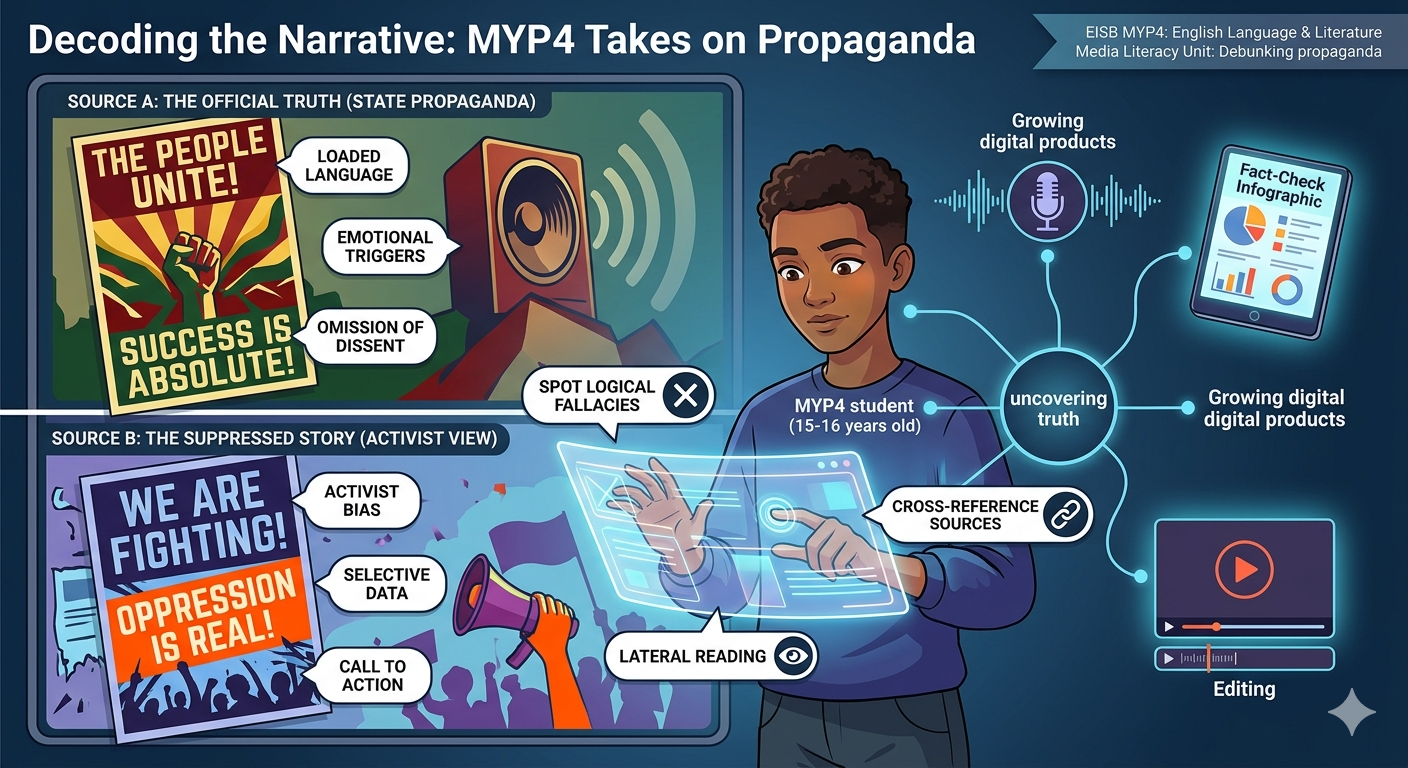
The core challenge of this unit pushes students well outside their comfort zones. They are given a single global event or controversial topic and tasked with analyzing two radically opposing sources . One might be a highly state-controlled media report, while the other is an activist blog or a rival international news agency.
The objective? To find the truth by themselves.
We aren’t giving them a cheat sheet or telling them what to believe. Instead, our MYP4s are acting as intellectual detectives. They are looking for the subtle mechanisms of manipulation:
-
Loaded Language: Spotting heavily biased adjectives designed to make readers feel rather than think.
-
Omission: Asking whose voice is missing from the story and why it was cut.
-
Logical Fallacies: Debunking arguments that rely on fear-mongering, false dichotomies, or circular reasoning.
By laying these texts side-by-side, students quickly realize that the truth rarely sits comfortably on either extreme. It requires cross-referencing, lateral reading, and a healthy dose of skepticism to uncover the facts hidden beneath layers of rhetoric.
The Outcome: Becoming Digital Truth-Tellers
To synthesize their findings, the students are currently channeling their inner journalists and media critics to produce a sophisticated digital product .
Moving away from traditional essays, they are using modern media to debunk modern media. Some students are recording podcast episodes where they debate the validity of their sources; others are producing highly detailed digital infographics that visually dissect the bias of specific headlines. We also have students editing video essays that contrast the visual imagery and music choices used by different networks to manipulate viewer emotion.
By creating these digital products, our MYP4 students are demonstrating a profound understanding of how media functions. They aren’t just learning how to avoid being fooled; they are learning how to use their own digital voices with integrity, clarity, and precision. We look forward to showcasing some of these exceptional digital projects across our school platforms soon!