
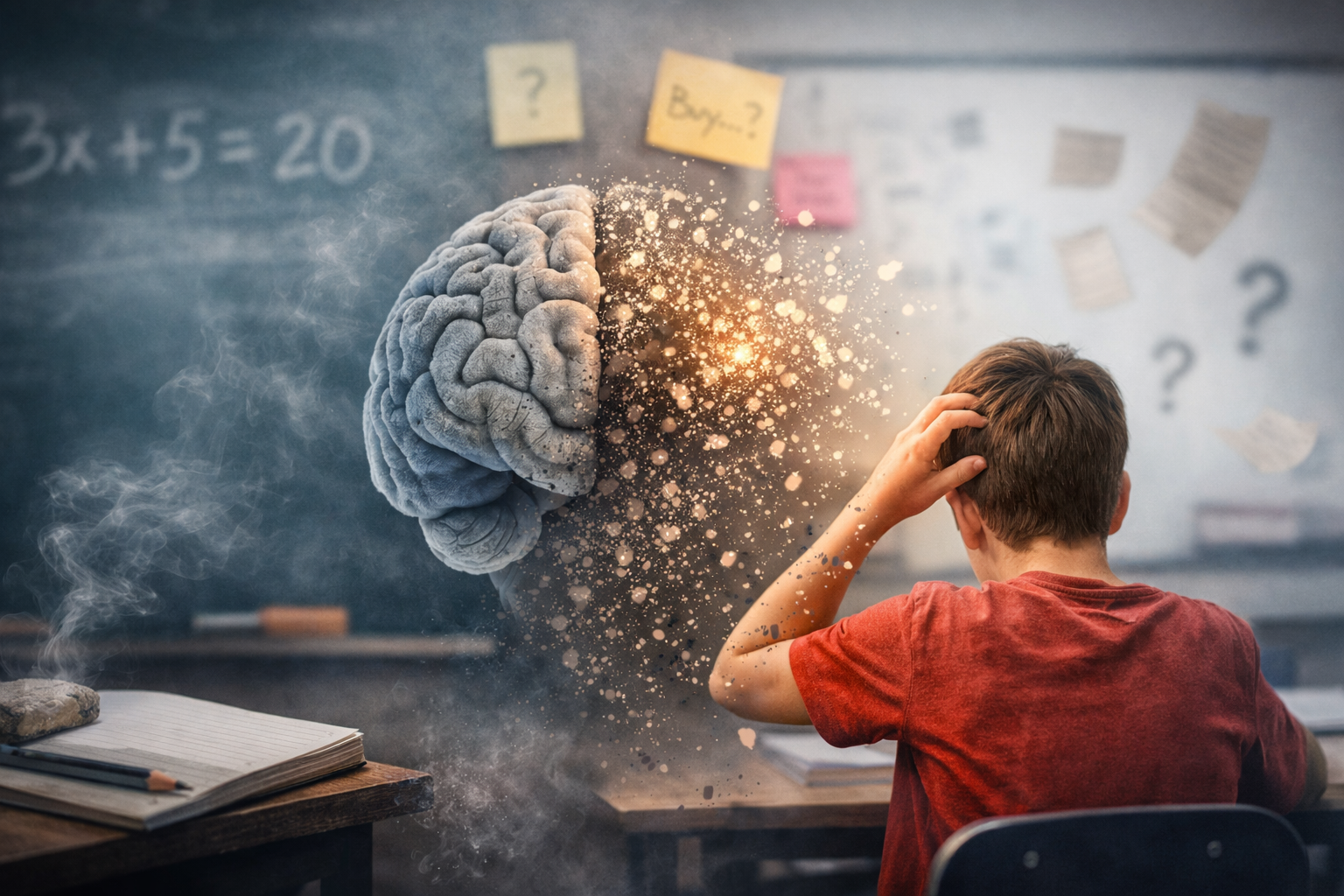
When Learning Doesn’t Stick – and How Deeper Learning Prevents It. Part 1: Why Students Forget
It happens to all of us.
You walk into a room and forget why you went there. You meet someone at an event, hear their name, smile, repeat it in your head—then it’s gone ten minutes later. You open your phone to check “one thing,” and suddenly you’re scrolling, unsure what task you meant to do. Even simple lists slip: milk, bread, batteries… until you stand in the aisle thinking, “I know there was one more.”
This isn’t proof that our brains are broken—it’s proof that memory has rules.
And those rules matter in school.
When students return after summer and seem to have “forgotten everything” in math or science, the issue often isn’t laziness or lack of ability. It’s that much of what looked like learning was stored too lightly—what researchers call shallow encoding—so without use, it fades fast, leaving students with a feeling of familiarity (“I’ve seen this before”) but not enough mental ownership to rebuild the skill on their own.
The brain does not store every experience the same way.
Some information sinks in deeply and stays with us for years. Other information barely settles before it begins to fade. Most of the time, forgetting isn’t a failure of intelligence or effort—it’s simply the result of how the information was stored in the first place.
This same principle explains something teachers around the world see every September.
Students return to school and suddenly struggle with material they appeared to understand only a few months earlier. A student who solved equations confidently in May may stare at a similar problem in September and say, “I forgot how to do this.” A science concept that seemed clear before summer break now feels unfamiliar.
Parents sometimes assume that students “lost everything over the summer.”
But in many cases, the learning never truly disappeared.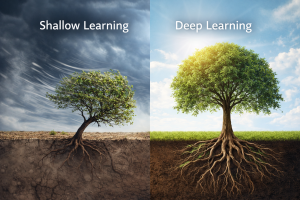
It simply wasn’t stored deeply enough.
Education researchers call this shallow encoding.
When learning is shallow, students can recognize information, repeat procedures, and sometimes even perform well on tests in the short term. But because the knowledge was not deeply connected to understanding, it fades quickly when it isn’t used.
Think about how we remember names. If you hear someone’s name once in passing, it often disappears within minutes. But if you speak with the person, learn something about them, repeat their name in conversation, and connect it to a story or experience, it becomes much easier to remember later.
The difference isn’t the name itself—it’s the depth of the experience surrounding it.
Learning works the same way.
Information that is merely heard, copied, or briefly practiced often sits near the surface of memory. Information that requires thinking, explaining, applying, or struggling through a problem sinks deeper into the brain’s network of knowledge.
And this is where modern learning conditions have begun to change how students experience knowledge.
Today, students live in a world where answers are often immediately available. Technology allows information to be retrieved instantly, and step-by-step explanations are easy to find. While these tools can be incredibly useful, they also reduce how often students must generate answers themselves.
But memory strengthens when we retrieve information, not when we simply recognize it.
Similarly, learning environments sometimes try to remove frustration from the learning process. Teachers understandably want students to feel confident and supported. Yet cognitive science consistently shows that productive struggle—the effort of working through confusion, testing ideas, and correcting mistakes—is one of the most powerful drivers of lasting learning.
When a problem is solved too quickly or with too much guidance, the brain may never fully build the connections needed to remember it later.
This doesn’t mean students aren’t capable.
It means the learning experience didn’t require enough ownership of the knowledge.
Subjects like mathematics and science reveal this pattern most clearly because they build layer upon layer of understanding. If a concept is only memorized as a set of steps, it may work temporarily but becomes fragile over time.
Students may remember the procedure while the lesson is fresh, but months later the steps fade because they were never anchored to a deeper structure of understanding.
The encouraging news is that this problem is not about ability. It is about how learning happens.
When students explore ideas, explain their thinking, apply knowledge in new situations, and persevere through challenging problems, learning becomes much harder to forget.
Understanding this difference between shallow learning and deeper learning is essential for educators and parents alike.
Because the real goal of education is not simply helping students perform well next week.
T
he goal is helping them build knowledge and skills that remain useful years later.
In the next article in this series, we’ll explore why shallow learning has become more common in modern education—and why struggle, perseverance, and active thinking are essential ingredients in learning that lasts.
#teachingtowardstomorrow