
We Feel, Therefore We Learn.
Rethinking the role of emotion in learning
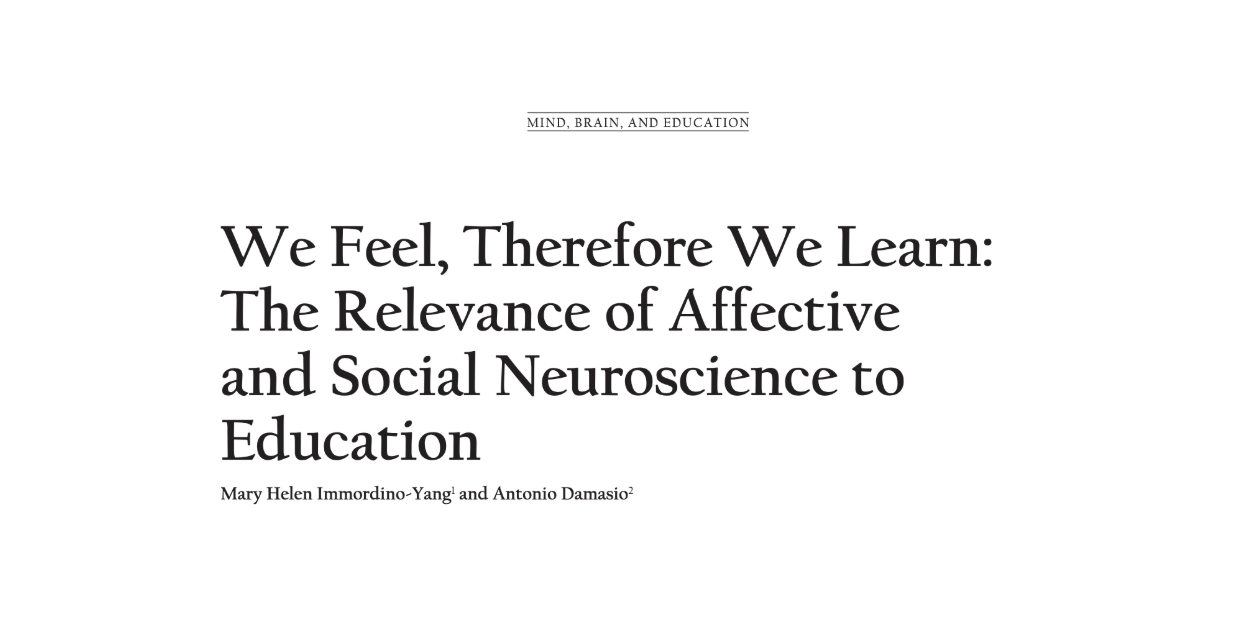
For many years, education has often treated learning as a primarily rational process, one that is focused on information, reasoning, and cognitive skills. However, neuroscience research challenges this assumption. In their article “We Feel, Therefore We Learn: The Relevance of Affective and Social Neuroscience to Education,” Mary Helen Immordino-Yang and Antonio Damasio argue that emotion is not separate from learning but deeply intertwined with it.
Drawing on research in affective and social neuroscience, the authors explain that key cognitive processes used in schools (e.g., attention, memory, decision-making, and social understanding) are fundamentally shaped by emotional processes. Rather than being purely logical systems that occasionally interact with feelings, these mental functions are embedded within what the authors describe as “emotional thought.”
In other words, emotion plays a central role in how we interpret information, form memories, and apply knowledge.
Insights from neuroscience
The article highlights evidence from neurological case studies that help to show the role of emotion in thinking. For example, individuals who have damage to areas of the brain associated with emotion can retain their intellectual abilities, yet they often struggle with everyday decision-making. While they may reason logically about a situation, they find it difficult to evaluate options, prioritise actions, or connect knowledge with meaningful outcomes.
These findings suggest that emotion functions as a kind of internal guide that helps us interpret information and make decisions. Rather than disrupting rational thinking, emotions help organise our thinking and connect knowledge with personal meaning.
Relevance to education
If emotion and cognition are inseparable, then effective learning environments must engage students emotionally as well as intellectually. In the article, Immordino-Yang and Damasio suggest that meaningful learning often emerges when students are encouraged to reflect, connect ideas to real-world contexts, and engage with topics that provoke curiosity, empathy, or moral consideration.
For schools, this research highlights the importance of learning environments that foster strong relationships, psychological safety, and opportunities for reflection. Classrooms that support discussion, collaboration, and authentic inquiry may allow students to engage more deeply with content because their emotional and social experiences become part of the learning process.
Implications for my own teaching practice
This research reinforces the idea that teaching is not simply about delivering content but about creating meaningful learning experiences. When students feel connected to their friends, their teachers, and the subject matter, they are more likely to engage deeply and retain what they learn.
For my own teaching practice, this perspective encourages me to create learning experiences that go beyond factual knowledge. For example, creating opportunities for students to discuss ideas, reflect on different perspectives, and connect learning to their own experiences and values. It also highlights the importance of building supportive classroom relationships (with both classmates and teachers), where students feel comfortable sharing ideas and taking risks in their learning.
This is one of my favourite research articles, and it has inspired my teaching since I first dived into this field of research 10+ years ago. It is important to remember that learning is both a cognitive and an emotional process. By recognising this, teachers (and parents) can develop better strategies to support the academic development of our students. We feel, therefore we learn.
Link to original article:
https://onlinelibrary.wiley.com/doi/full/10.1111/j.1751-228X.2007.00004.x