
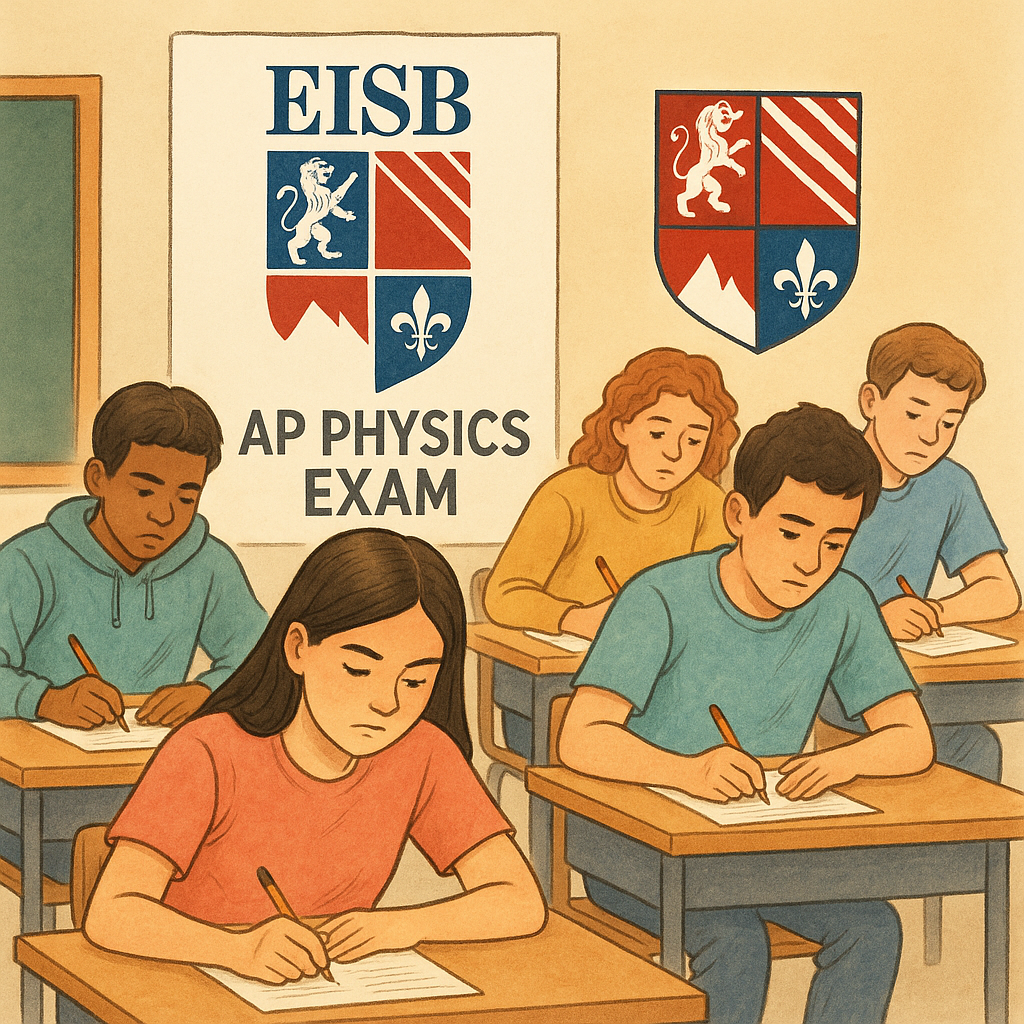
AP Physics , A Journey of Preparation, Perseverance, and Growth at EISB
At EISB, we believe that true learning happens when students are challenged and supported at the same time. This year, several of our senior students took on the demanding yet rewarding journey of preparing for the AP Physics 1 exam—an essential milestone for many who aim to study at universities across Europe. As their physics teacher, I had the privilege of walking alongside them through this intense experience, and I now share their reflections, learnings, and advice for the next generation of EISB learners.
The AP Physics 1 exam is rigorous, covering a wide range of topics such as kinematics, forces, energy, momentum, rotational motion, and fluids. While some students came into the course with a solid background in the foundational topics, challenges quickly arose with more complex areas like rotational motion and the newly added topic of fluids. These were not only conceptually demanding but also required a deeper level of problem-solving and explanation—something that can’t be mastered overnight.
One thing became clear early on: preparation for the AP exam must begin as early as possible. Waiting until mid-year is simply not enough. That’s a message our students echoed as they looked back on their experience. The exam demands not only technical knowledge but also the ability to clearly and concisely explain physical phenomena in written form—particularly in the free-response section, where students must answer in complete sentences, using scientific reasoning rather than just equations.
To support their growth, I encouraged students to go beyond classwork by exploring resources such as the College Board videos, practice questions, and past AP exam papers. Initially, some began with platforms like Khan Academy, but they quickly discovered that it didn’t reflect the actual structure of the AP questions. We adapted. I helped them locate more accurate materials and guided them through targeted practice sessions, especially with the difficult fluid dynamics questions where resources were scarce. Their determination was remarkable, and I was proud to see how they took ownership of their learning, continually improving their skills and understanding.
One common challenge many faced was time management during the multiple-choice section. Some students spent too much time on complex problems early in the test, which limited their ability to complete the rest. They now recommend marking difficult questions and returning to them after the easier ones—an effective strategy to avoid being pressed for time.
Through trial, error, and consistent effort, each student learned valuable lessons not just about physics, but about themselves. They built confidence, learned to handle academic pressure, and discovered the importance of persistence and planning. These are lessons that go beyond the classroom—and ones they will carry with them into their future studies and careers.
To those preparing for the AP Physics 1 exam in the coming years, let this be your takeaway: start early, stay curious, and don’t be afraid to ask for help. Use your resources wisely, especially those that reflect the real AP question format. Practice explaining concepts as clearly as you would teach them to someone else. Don’t just memorize formulas—understand the reasoning behind them. And trust that your hard work will pay off.
As their teacher, I’m incredibly proud of the resilience and maturity our students have shown. Their stories are proof that success is not only about scores—it’s about growth. The AP Physics journey at EISB is a powerful one, and I look forward to seeing how the next generation embraces it with the same spirit of courage and curiosity.