AP Lang Students Turn Argument Errors into Teaching Tools
Strong argument writing is not only about knowing what to do. Sometimes, students learn just as much by studying what not to do.
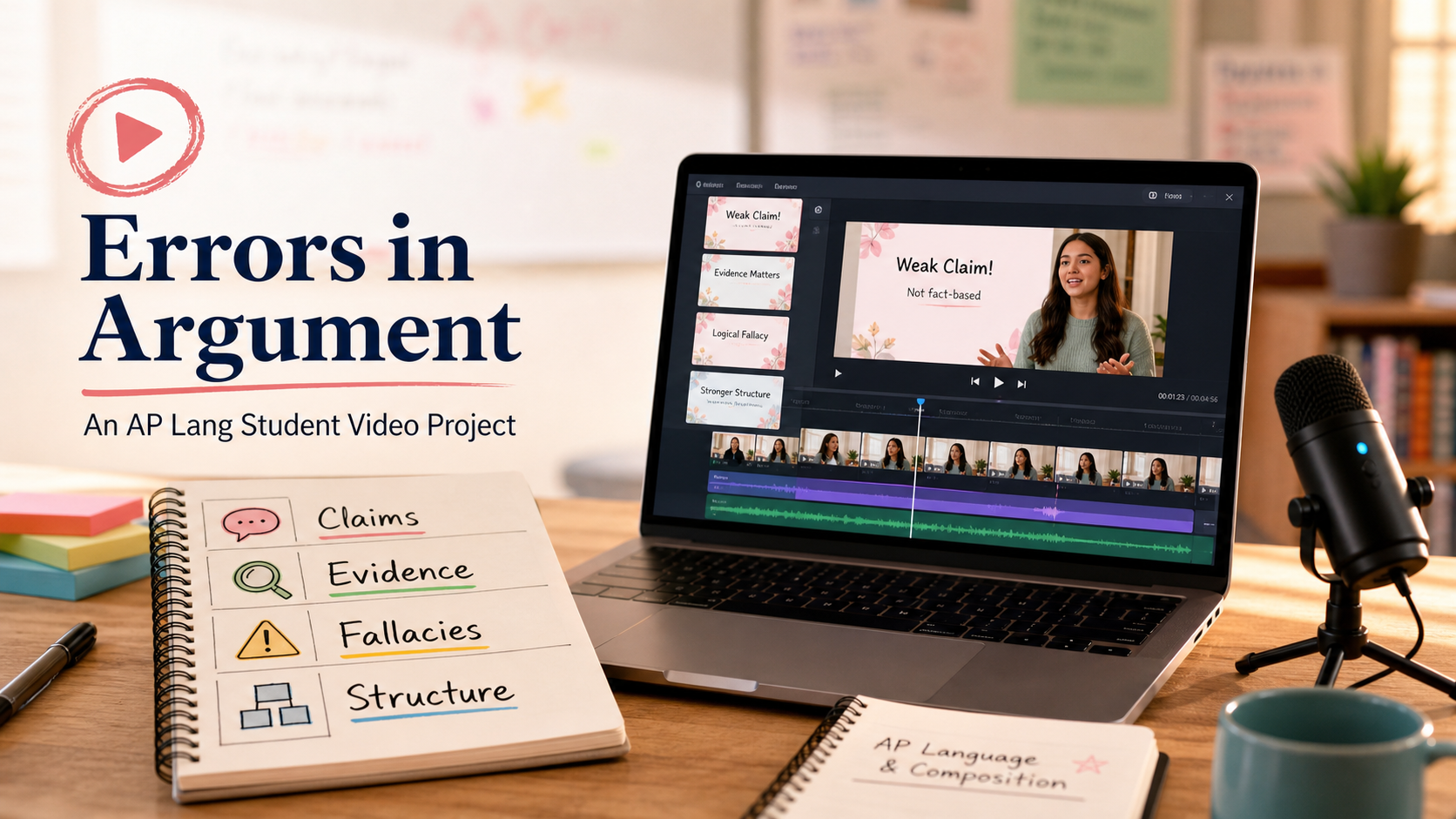
This semester, AP Language and Composition students completed an instructional video project titled “Errors in Argument: What Not to Do in the AP Lang Argument Essay.” The project asked students to move beyond simply naming mistakes. Their goal was to teach through critique: identify an error, explain why it weakens an argument, and then model a stronger version. The assignment is connected directly to the argument skills developed in The Language of Composition, especially claims, evidence, fallacies, and the shaping of argument.
Learning argument by diagnosing weak arguments
The project focused on four major problems that often weaken AP Lang argument essays: flawed or absent claims, weak or irrelevant evidence, logical fallacies, and disorganized reasoning. Each group created a polished instructional video with an introduction, four teaching sections, and a final takeaway. Each section required a definition, a researched example, an evaluation of why the example failed rhetorically, a revised version, and an on-screen tip for writers.
This structure pushed students to do more than memorize terminology. They had to apply rhetorical thinking. A weak claim, for example, is not just “bad writing.” It may be too broad, too factual to debate, unclear in its position, or built on undefined terms. Students had to find real examples of weak or unclear claims from credible sources, identify the type of claim being made, and revise it into something more precise and defensible.
That process mirrors the actual AP Lang writing task. A strong argument essay begins with a claim that can be defended. If the claim is vague, double-sided, or merely factual, the rest of the essay has no clear direction. By teaching this problem to others, students strengthened their own understanding of what a thesis needs to do.
Evidence that does real work
Students then turned to one of the most common problems in argument writing: weak evidence. In AP Lang, evidence must be relevant, accurate, and sufficient. It should also show variety, including examples such as expert opinion, quantitative data, historical examples, current events, or firsthand and secondhand evidence.
For the video, students found examples of misused or weak evidence, such as vague generalizations, statistics without context, misleading comparisons, or anecdotes treated as universal proof. They also had to locate a stronger piece of evidence to repair at least one weak example.
This was an important step because students often assume that including evidence is enough. It is not. Evidence has to be interpreted. It has to connect to the claim. It has to help the reader understand why the argument is reasonable. The video format made that visible: students had to show the weak evidence, explain the problem, and then demonstrate how stronger evidence changes the quality of the argument.
Making fallacies visible
The logical fallacies section gave students a chance to examine how arguments can appear persuasive while actually relying on faulty reasoning. Groups researched fallacies from public discourse, including advertisements, opinion pieces, political commentary, and influencer arguments. They needed to include multiple fallacy types, such as ad hominem, straw man, slippery slope, hasty generalization, or false dilemma.
In the final video, students explained how these fallacies damage both logos and ethos. A fallacy does not only weaken the logic of an argument. It can also make the speaker seem less credible, less fair, or less informed. By rewriting the arguments to remove the fallacy, students practiced a more mature skill: not just spotting the error, but improving the reasoning.
That distinction matters. AP Lang students should not study fallacies only to “catch” someone else being wrong. They should study them to make their own writing more precise, fair, and convincing.
Structure as a form of reasoning
The final section of the project focused on organization. Students examined an argument that was hard to follow because of a buried claim, jumpy logic, or weak transitions. Then they reorganized it using a clearer structure, such as the Classical model or the Toulmin model.
This part of the project reminded students that structure is not decoration. Structure is reasoning. A reader should be able to follow how a claim leads to evidence, how evidence connects to a warrant, and how the writer handles possible objections. The Toulmin model helped students see argument as a system: claim, grounds, warrant, backing, qualifier, and rebuttal.
In the final product, the students used visual explanation to make that system easier to understand. They mapped the parts of an argument and showed how clearer arrangement can turn scattered ideas into a more convincing line of reasoning.
Research, credibility, and source responsibility
One of the strongest parts of the assignment was its research requirement. Students could not invent all of their examples. Across the full video, they needed to include at least eight researched examples from credible sources, including different source types such as reputable news, editorials, academic sites, nonprofits, government sources, published speeches, or textbook examples.
They also had to avoid random quote sites, unsourced screenshots, and anonymous posts. If they used social media, it needed to come from a credible account with clear source information.
This requirement connected the project to a larger AP Lang habit: writers must handle sources responsibly. A strong argument depends not only on having something to say, but also on showing where evidence comes from and why it deserves trust.
Turning AP skills into a teaching product
The final video showed students using AP Lang concepts in a creative, student-friendly format. They defined key terms, displayed examples, explained rhetorical problems, and offered improved versions. They also used on-screen labels, source credits, visuals, and purposeful edits to guide their audience through the lesson. The project required clear audio, readable text, a complete research log, and a finished video with all four sections in order.
This kind of project matters because it transforms exam preparation into authorship. Students were not only preparing to write argument essays. They were designing a resource that could help other students avoid common mistakes.
By the end, they had practiced thesis writing, evidence evaluation, fallacy analysis, source selection, visual organization, and audience awareness. Those are AP exam skills, but they are also real-world communication skills.
A good argument does not happen by accident. It depends on a clear claim, relevant evidence, sound reasoning, fair treatment of opposing views, and a structure readers can follow. Through this video project, AP Language and Composition students learned that the best way to avoid errors in argument is to understand exactly how those errors work.