
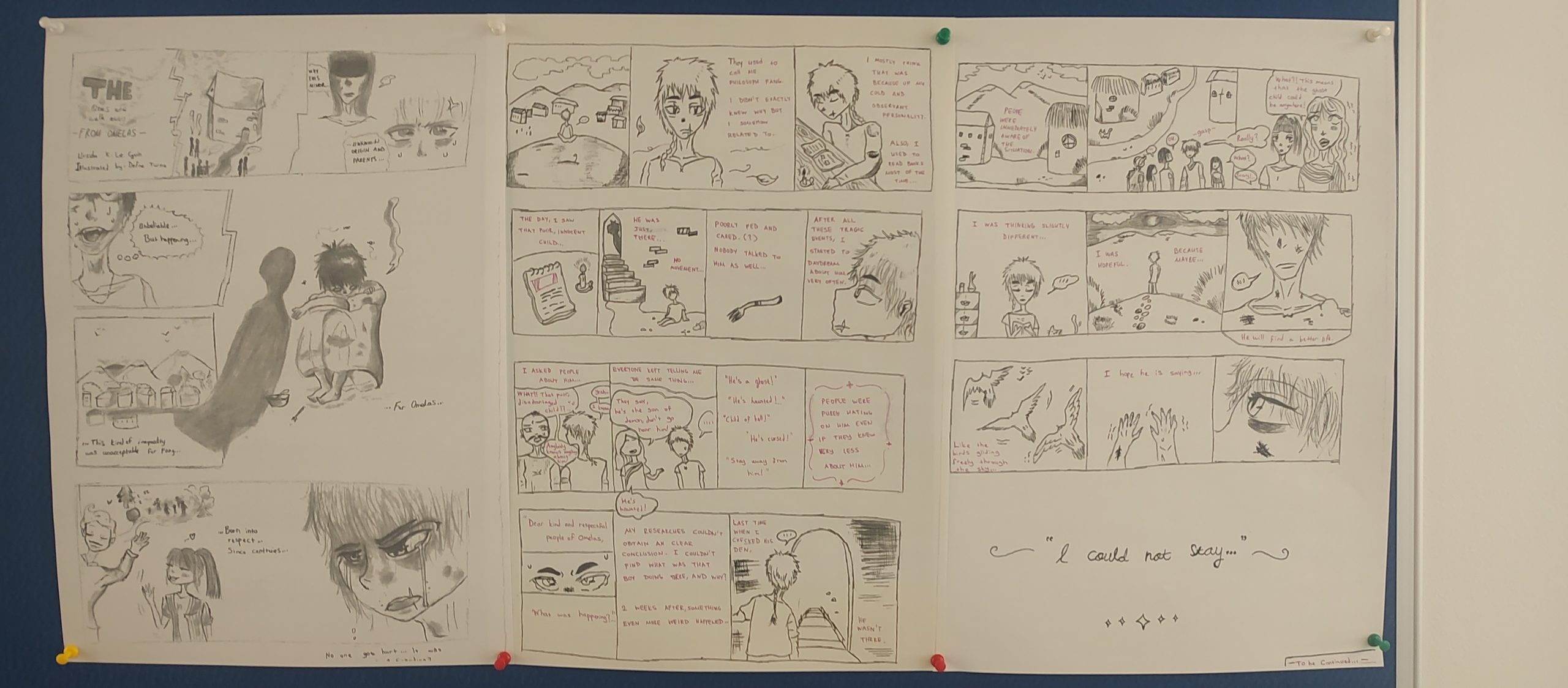
Beyond the Gates: Defne I. Turna’s Visual Reimagining of Omelas
In our MYP4 English Language and Literature class, we recently concluded a unit that challenged students to look beneath the surface of the stories we consume. By exploring the themes of power, voices, and resistance, we asked our students to consider not just what a story says, but whose voice is silenced and how individuals can stand against systemic injustice. To ground these heavy concepts, we turned to one of the most haunting pieces of philosophical fiction in the English language: Ursula K. Le Guin’s “The Ones Who Walk Away from Omelas.”
The story presents a “perfect” utopia where everyone is happy, yet this happiness is entirely dependent on the abject misery of a single child locked in a basement. While most citizens accept this trade-off, some choose a silent path of resistance: they simply walk away. For our students, the question was never just about why they leave, but where they go and what happens next. Defne Turna took this inquiry a step further by deciding to bridge the gap between literature and visual art, creating an original comic that explores a possible ending to Le Guin’s narrative.
Defne’s choice to use the comic medium was particularly insightful for this unit. By illustrating the transition from the vibrant, saturated colors of the festival of Omelas to the stark, uncertain shadows of the world outside, she captured the emotional weight of resistance in a way that words alone sometimes cannot. Her work doesn’t just “tell” an ending; it “shows” the internal struggle of choosing morality over comfort. She effectively gave a voice to the silent wanderers, visualizing the physical and mental landscape of those who refuse to be complicit in a cruel system.
We are incredibly proud to share that Defne’s comic is now on display for the entire community to appreciate. You can find her work showcased on one of the main school billboards, where students from all year groups are stopping to read, reflect, and discuss her interpretation. Seeing such a complex literary analysis move from a classroom assignment to a public piece of art is exactly the kind of “inquiring leadership” we foster at EISB. It reminds us all that literature is not a passive experience; it is a call to think, to imagine, and sometimes, to walk toward a more ethical horizon.

Awesome! Its genuinely remarkable post, I have got much clear idea regarding from this post
I truly appreciate your technique of writing a blog. I added it to my bookmark site list and will
There is definately a lot to find out about this subject. I like all the points you made