The AI Paradox: Navigate the Digital Frontier with Purpose
Walking through the corridors of EISB, it’s impossible to ignore the “silicon elephant” in the room: Artificial Intelligence. In just a few years, AI has shifted from a sci-fi concept to a permanent resident in our classrooms. As educators, we find ourselves at a fascinating, albeit challenging, crossroads. Is AI a threat to the traditional foundations of learning, or is it the ultimate catalyst for human potential? The answer, as it often does in History, Individuals and Societies, or Literature, depends entirely on intent.
The Problem: When AI Becomes a “Shortcut”
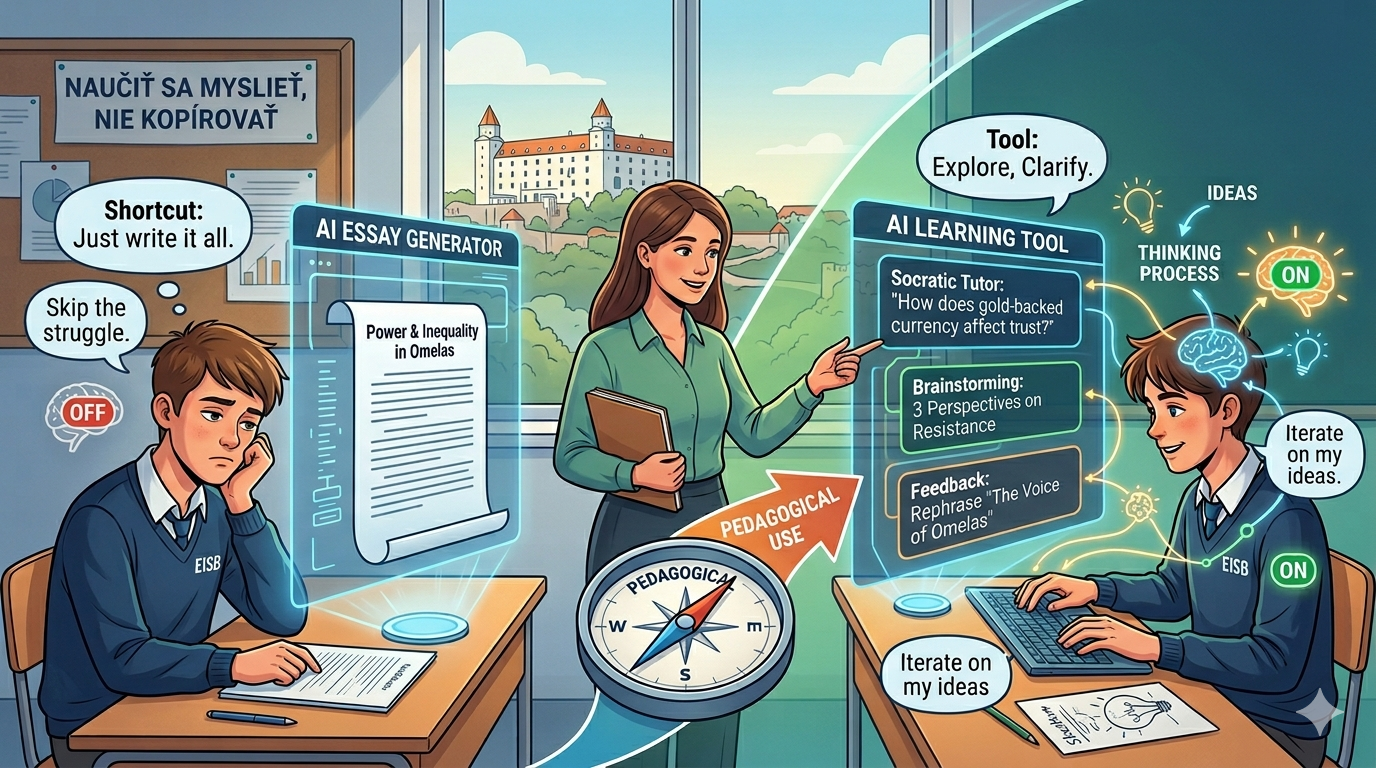
The most immediate concern with AI in education is the temptation of the “easy out.” When a student uses a Large Language Model to generate an entire essay or solve a complex set of equations without engaging with the underlying logic, they aren’t just “saving time”, they are bypassing the very struggle that creates intelligence.
Learning is, by definition, a process of cognitive friction. It’s in the “messy” middle where we struggle to find the right word, fail to balance an equation, or grapple with the ethics of a resource like oil that neural pathways are forged. If AI is used as a method to avoid the work, the student becomes a mere “prompt engineer” rather than an inquiring leader. The result is a finished product with zero internal growth. This is the “Shortcut Trap,” and it’s a hurdle we must navigate with honesty and high standards.
The Potential: AI as a Powerful Pedagogical Tool
However, to dismiss AI entirely would be a disservice to our students’ futures. When used correctly, AI is perhaps the most versatile learning tool ever invented. Think of it not as a ghostwriter, but as a high-powered “scaffold.”
-
The 24/7 Socratic Tutor: AI can explain a complex concept like cultural syncretism or the Zimbabwe Gold (ZiG) in ten different ways until it finally clicks for a specific student.
-
The Brainstorming Partner: It can help a student move past “blank page syndrome” by generating five different perspectives on a literary theme, which the student then must critique, expand upon, and verify.
-
Personalized Feedback: It can offer instant critiques on grammar or coding logic, allowing students to iterate and improve their work in real-time before they even step into the classroom.
The EISB Stance: Process Over Product
At EISB, our focus remains steadfastly on the process of learning. We aren’t just interested in the final comic about Omelas or the Prezi on petro-politics; we are interested in the research, the critical thinking, and the personal voice that went into them.
“AI should be the wind in our sails, not the engine that steers the ship.”
Our goal is to form inquiring leaders who know how to use these powerful models ethically and effectively. We encourage our students to use AI to clarify doubts and expand their horizons, but to double and triple-check any information AI generates. After all, a machine can mimic a voice, but it can never possess the empathy, the multicultural mindset, or the perspective that our students bring to the table every day.
The future isn’t about avoiding AI, it’s about out-thinking it.
How are you using AI at home? Are you finding it helps or hinders your child’s natural curiosity?