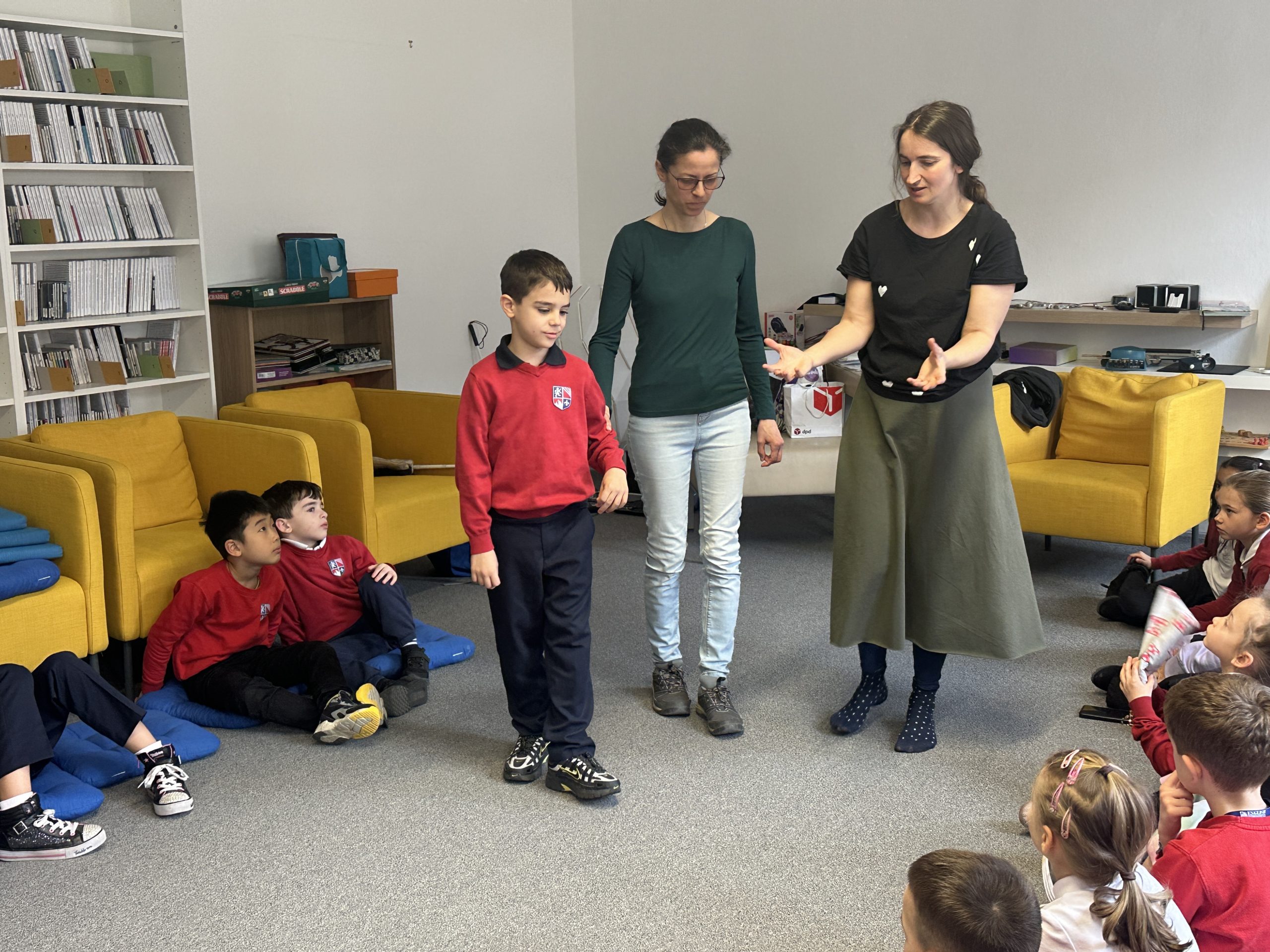
Hands, Hearts, and Heroes: Our Unforgettable Visit to the Library
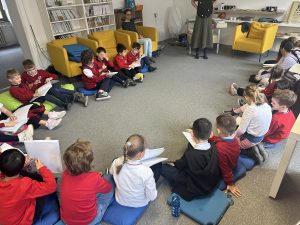
Today, our Year 2 and Year 3 students stepped out of the classroom and into a world seen not with the eyes, but with the fingertips and the imagination. We visited the specialized department at the City Library dedicated to people with visual impairments.
The goal? To foster empathy, understanding, and awareness in our young learners about the diverse ways people navigate the world.
The Magic of Six Dots: The World of Braille
The morning kicked off with a captivating presentation titled “The World of Braille.” Our presenter shared the incredible story of Louis Braille, a French boy who lost his sight at the age of three. By the time he was just 15 years old in 1824, he invented the system we still use today.
The children learned that Braille isn’t a language—it’s a code! Here are a few fascinating facts they discovered:
-
The “Cell”: Every Braille character is based on a “cell” of six possible raised dots.
-
Speed Reading: Experienced Braille readers can read at about the same speed as people reading with their eyes—roughly 115 words per minute!
-
Universal Reach: Because it is a code, Braille can be adapted to almost any language, from English to Arabic, and even musical notation.
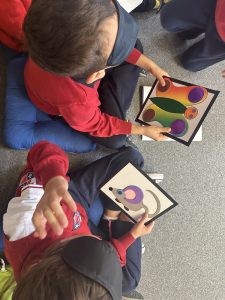
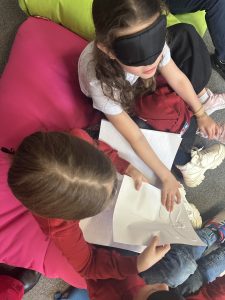
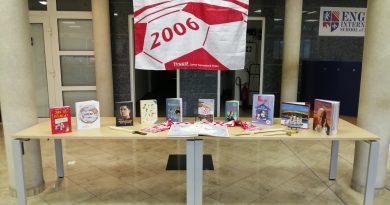
The highlight was when the students got to touch Braille books. Their faces lit up as they felt the textured pages, realizing that “reading” can happen through the skin. They even took part in a sensory challenge: wearing blindfolds, they tried to identify shapes on paper using only their sense of touch. It was a humbling lesson in how much we usually rely on our eyes.
Maxim Leads the Way: How to Be a Helpful Friend
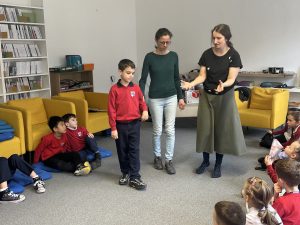
A very special moment occurred when Maxim (Year 3) stepped up to demonstrate how to assist someone using a white cane (the correct term for the tool used by people with visual impairments).
Through a role-play exercise on “crossing the street,” the children learned the Golden Rules of being a sighted guide:
-
Ask First: Always approach and ask, “Would you like some help?” Never grab someone without permission.
-
The Human Guide Technique: If they say yes, let the person hold your elbow or shoulder.
-
Lead, Don’t Pull: The guide walks slightly ahead, and the person in need follows your movements.
-
Be Clear: Use descriptive words like “The curb is coming up in two steps,” rather than saying “Over there.”
The Superpower of Focused Hearing
One of the most common questions from the students was: “Do they have super-hearing?” We took a moment to explain the science behind this. It is a common misconception that people with visual impairments are born with better hearing; in reality, their brains undergo a process called neuroplasticity. Because they cannot rely on sight, the brain “rewires” itself to pay much closer attention to auditory cues. They learn to use echo-location (the way sound bounces off walls) and subtle changes in wind or noise to map out their surroundings. It isn’t a “magic” sense, but rather a remarkable display of focus and practice.
Why This Matters
This trip was about so much more than just books. By the end of the day, our students walked away with:
-
Increased Empathy: Understanding that having a visual impairment doesn’t mean “missing out,” but simply doing things differently.
-
Practical Skills: Knowing exactly how to be a helpful, respectful citizen.
-
Confidence: Reducing the “fear of the unknown” that often leads to staring or avoidance.
It was a beautiful, enriching experience that reminded us all that while we may see the world differently, we all share the same community.