
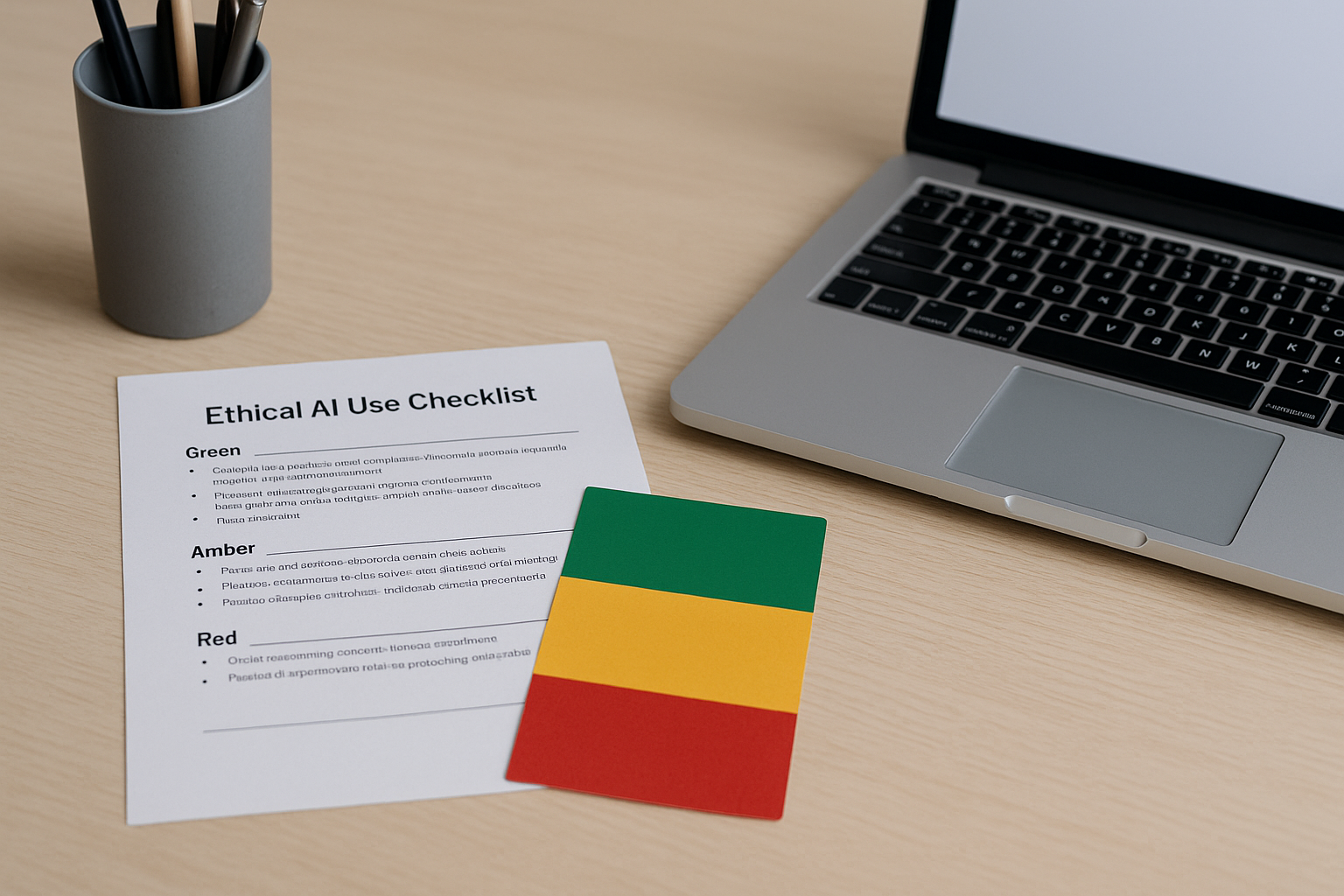
The Academic Honesty Upgrade: Ethical AI Use
Why this matters
AI can accelerate learning or short-circuit it. The difference is intent, transparency, and the steps you take to verify and transform any assistance. Below is an acceptable approach: use AI to plan, practice, and clarify—not to replace your thinking.
The traffic-light rules
✅ GREEN — Generally allowed (and encouraged)
Use AI to learn, not to write for you.
Idea exploration: “Give me 5 angles to analyze surveillance in dystopian fiction.”
Planning/outlining: “Based on these notes, suggest 2 outline options. I will choose and edit.”
Language clarity: “Point out 3 sentences that read awkwardly and explain why.”
Study drill: “Generate 10 quiz questions from the following class notes.”
Source finding: “List three credible starting points for research on microplastics; no paywalled blogs.”
Keep: Your voice, your reasoning, your structure.
Do: Save prompts; cite the sources you actually read, not the AI.
⚠️ AMBER — Allowed with caution (declare it)
Requires verification and an AI Use Declaration attached.
Summaries of sources you’ve read: Ask AI to compress your notes; double-check accuracy.
Paraphrase coaching: “Suggest alternatives to this sentence while preserving meaning.” You still decide.
Practice examples: “Create a sample Paper 1 paragraph on tone using my evidence” → you annotate what works/what doesn’t.
Rule of thumb: If the AI’s words end up on the page, you must transform them and declare the assistance.
⛔ RED — Not allowed
Academic misconduct.
AI writes your paragraphs or analysis; you “lightly edit.”
Fabricated quotes/citations/page numbers/data.
Skipping reading (“Tell me what Ham on Rye means so I can write my essay”).
Translating an article and submitting it as your own work.
Planning prompts that keep you in the Green
Copy/paste into your notes and adapt:
“From these class notes (pasted below), generate 5 questions I should be able to answer after revising.”
“Offer two outline options for a 900-word analysis using the evidence I provide. Label weaknesses.”
“Identify gaps in my reasoning and suggest what additional evidence would help.”
“Give me a 3-step revision plan to improve clarity and cohesion, with examples.”
The reflection log (3 sentences max)
Add this to the end of your draft (or staple the declaration form):
What AI did I use, for what step?
What did I keep/change after verifying?
What part is unmistakably my own (insight, structure, voice)?
Citing when AI is involved
Cite sources you actually consulted, not the AI.
If the teacher requests disclosure, add a note like:
“AI assistance: brainstorming outline ideas and grammar suggestions. All ideas/wording are my own unless cited.”
For factual claims, pin a source (author, title, year, page/URL). Avoid “AI says…”
Quick classroom scenarios
Paper 1 practice: You paste your paragraph; AI highlights vague verbs and suggests 3 stronger alternatives. You choose, rewrite, and explain why. Green.
IO prep: AI helps you brainstorm global-issue angles for your chosen pair; you pick one and build your own outline. Green.
Paper 2 draft: AI generates a “model paragraph” you submit mostly unchanged. Red.
HL Essay: You wrote it; AI checks cohesion and flags repetition; you revise and log the assistance. Amber → declare.