
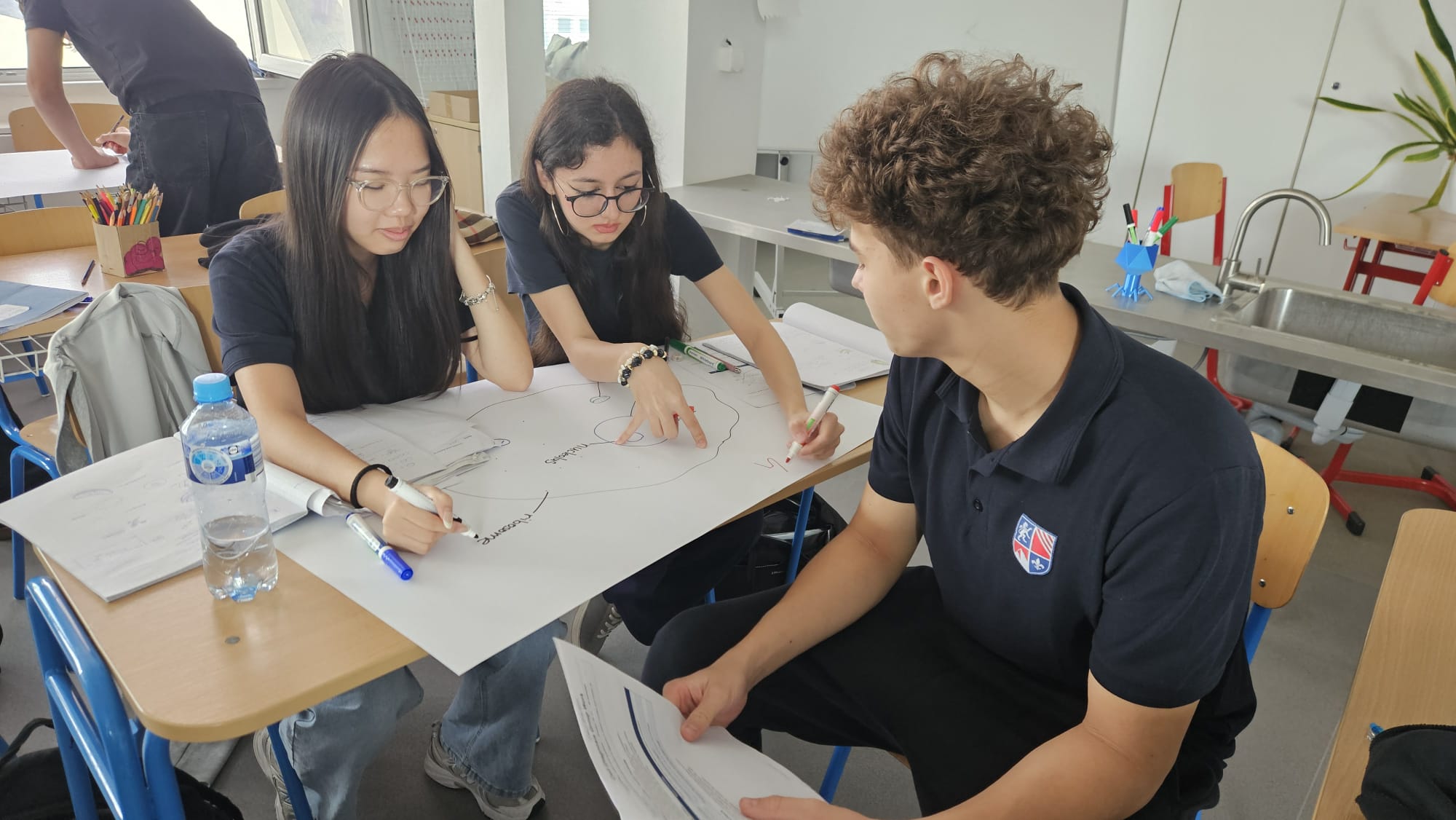
Cell Detectives: From Case to Concept Map
Why might a cell be able to synthesize proteins but fail to export them? Why might a plant be capable of producing sugars through photosynthesis, yet still struggle to grow? As part of a mini-project titled “Cellular Diagnostics,” Y10-11 students investigated various cellular “malfunctions,” drawing upon their knowledge of organelles and how they interact.
The project consisted of three stages: analyzing a specific scenario, following detailed instructions, and creating and publicly presenting a group mini-project.
Team formation began with a random draw: students picked slips of paper to form groups of two to three. Each group received a specific task and assigned roles based on the provided guidelines—some members focused on studying the assignment, others on creating diagrams and verifying facts and terminology, and others on formulating final conclusions.
The students discussed their assigned scenario, analyzed the “evidence,” and addressed guiding questions. Their objective was to identify the cellular issue and justify their diagnosis from a biological perspective.
Next, the students reviewed the requirements for presenting their findings: they were tasked with creating a conceptual map on a poster. Each poster had to include:
– The cell type (plant, animal, or bacterial), supported by at least three structural characteristics that confirm this classification.
– A description of the organelle or structure involved in the issue, along with its normal function.
– A chain of cause-and-effect relationships (consisting of at least four stages) that links the initial problem to the disruption of a biological process, its consequences for the cell, and its overall impact on the entire organism. – A diagram connecting at least three organelles or cellular structures, with explanations provided along the connecting arrows.
– One complex question to another group.


A key requirement was to explain the interrelationships. Simply mentioning an organelle was not enough; students had to demonstrate how a change in one part of a cell could affect other processes and, ultimately, the entire organism.
Following this, the groups organized their findings onto posters and presented them to the class. During their presentations, the students explained the diagnoses they had reached and justified the connections depicted in their diagrams. Regardless of their assigned roles, every participant was expected to have a deep understanding of the solution their group proposed.
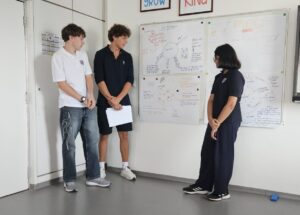
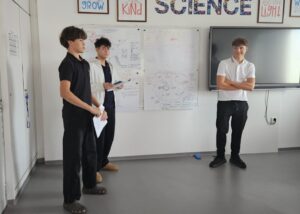
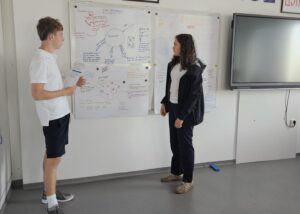
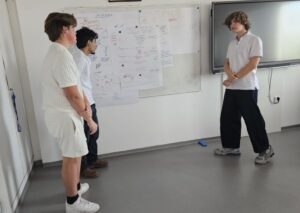
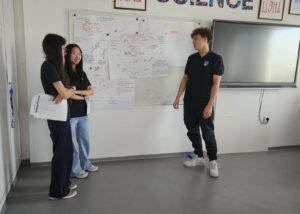
From the initial discussion to the final presentation, the “Cellular Diagnostics” project integrated biological knowledge, careful study of materials, shared responsibility, and scientific communication. The completed posters made the students’ reasoning process visible—providing them with concrete material to explain and defend.
Use of case-based learning in lessons helps students develop critical thinking skills and the ability to establish cause-and-effect relationships.