Deconstructing the Dialogue: MYP4 Yagmur Dissects Modern Rhetoric
Our MYP4 English Language and Literature students continue to impress us with their razor-sharp media literacy skills. As part of our ongoing unit on language, truth, and propaganda, students have been acting as intellectual detectives, uncovering the subtle mechanisms of persuasion that flood our daily lives.
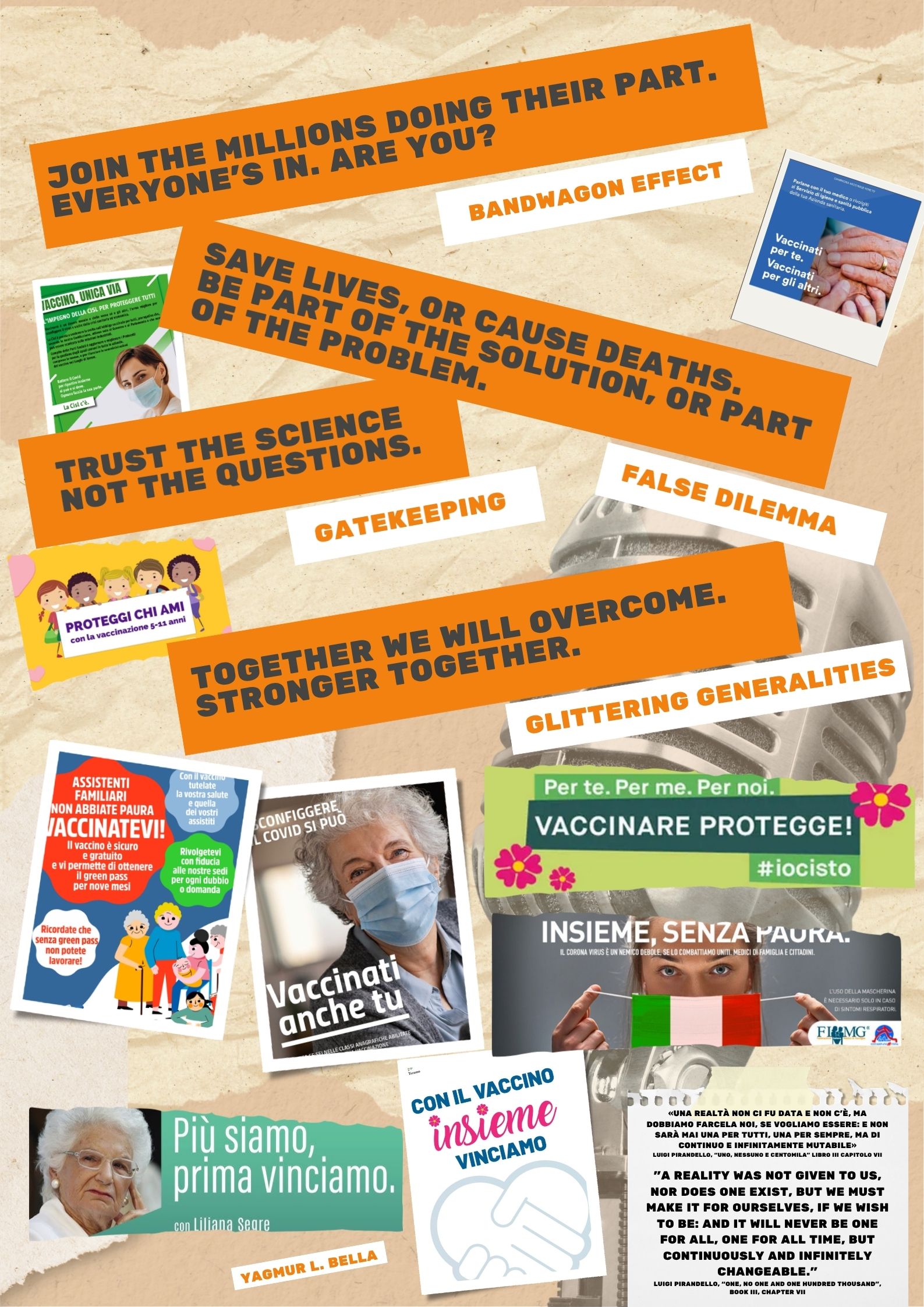
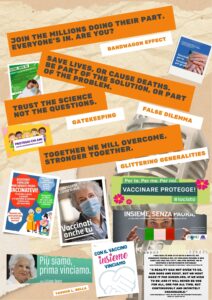
Today, we are thrilled to feature a brilliant visual analysis created by Yagmur L. Bella. Yagmur’s poster takes an analytical look at the rhetorical strategies deployed in major public campaigns in Italy during the COVID-19 pandemic, showing how language can be used to steer collective behavior.
The Anatomy of Persuasion: Four Key Techniques
Yagmur’s poster serves as a masterclass in media dissection. Instead of passively accepting public messaging, he carefully isolated real-world media snippets and overlaid them with bold orange banners that translate and expose the underlying communication techniques:
-
The Bandwagon Effect: By highlighting phrases like “Join the millions doing their part. Everyone’s in. Are you?”, Yagmur exposes how media can leverage our natural human desire for belonging to encourage social conformity.
-
The False Dilemma: His analysis perfectly captures the polarizing nature of binary choices with the banner: “Save lives, or cause deaths. Be part of the solution, or part of the problem.” Yagmur correctly identifies this as a classic framing trap that eliminates nuance, forcing the audience into a strict “either/or” mentality.
-
Gatekeeping: With the phrase “Trust the science, not the questions,” Yagmur highlights how mass communication often oversimplifies complex topics for the sake of a unified message. While official campaigns aim for clear, actionable guidance during a crisis, looking at this through a media literacy lens reveals how public rhetoric can sometimes discourage the very spirit of critical questioning and open inquiry that drives academic growth.
-
Glittering Generalities: Yagmur identifies vague, emotionally charged slogans—such as “Together we will overcome. Stronger together.” revealing how high-sounding words are used to comfort and unite a population without necessarily offering concrete details.
A Philosophical Finish
What elevates Yagmur’s project from a standard media analysis to a deeply conceptual piece of work is his inclusion of a quote from the famous Italian dramatist and philosopher Luigi Pirandello at the bottom of his display:
“A reality was not given to us, nor does one exist, but we must make it for ourselves, if we wish to be… It will never be one for all, one for all time, but continuously and infinitely changeable.”
By pairing Pirandello’s words from One, No One and One Hundred Thousand with modern media artifacts, Yagmur demonstrates a profound truth: the narratives presented to us in public spheres are carefully constructed frameworks. It is our job as critical thinkers to look beneath the surface, weigh the evidence, and analyze the messaging objectively.
Yagmur’s project is a stellar representation of inquiring leadership in action. By learning to dismantle these linguistic structures today, he and his MYP4 peers are ensuring they will be analytical, independent thinkers in the world of tomorrow.
Fantastic work, Yagmur!