The Art of the Unsaid: MYP5 Explores Connection and Subtext
Language is a bridge, but it can also be a wall. As our MYP5 English Language & Literature students enter their final unit of the year, they are stepping into a deeply nuanced intellectual territory. In Unit 5, titled “The Space Between Us: Connection, Distance & What We Leave Unsaid,” the focus shifts from what characters say to what they deliberately hold back.
Throughout this unit, the classroom has transformed into a laboratory for human emotion and identity. Our students are no longer just looking at plots; they are investigating the subtle, hidden architecture of human communication across three distinct media: poetry, short stories, and theater.
Masking and Revealing: Language Across Media
The core inquiry of this unit revolves around a fascinating paradox: how can language be used to express our truest feelings and identities, while simultaneously being weaponized to hide them?
Every medium handles this “space between us” differently, and our MYP5s are discovering how to decode these structural choices:
-
In Poetry: Students are analyzing how poets use line breaks, rhythm, and metaphor to give form to abstract feelings of isolation or intimacy—saying everything by saying very little.
-
In Prose: They are exploring how short story authors manipulate narrative perspective, showing readers the painful distance between a character’s internal thoughts and their external dialogue.
-
In Theater: Drama provides perhaps the ultimate test of subtext. By reading play scripts, students are learning that dramatic tension often lives in the pauses, the stage directions, and the words characters choose not to say to each other on stage.
Through these texts, the class realizes that identity is rarely static. We use language to signal who we are, but we also use it as a shield to protect ourselves from vulnerability.
Stepping Up to the DP: The Rigor of the Written Word
MYP5 is a beautiful year of transition, but it is also a demanding one. With the rigorous IB Diploma Program (DP) looming on the horizon, our students need to shift from guided classroom discussions to independent, rapid literary analysis. To build the stamina and critical depth required for the next phase of their educational journey, we have raised the academic stakes in Unit 5.
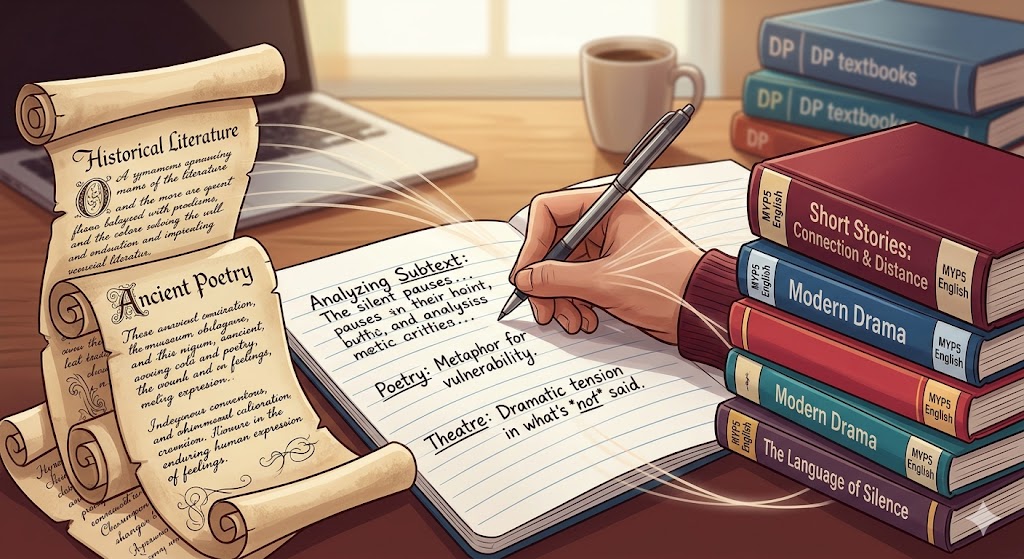
Every single week, each MYP5 student is required to submit a handwritten analytical entry reflecting on the weekly reading.
This is a deliberate pedagogical choice. The DP language and literature exams are notoriously demanding, requiring hours of sustained, handwritten analytical commentary. By enforcing a weekly pen-to-paper routine now, we are helping our students build the physical muscle memory and mental stamina they will need to succeed under exam pressure.
Furthermore, as we have explored earlier this year, handwriting forces a slower, more intentional processing of information. When students sit down with a blank page and a pen to analyze how a playwright uses silence, they cannot simply copy-paste or rely on digital editing tools to clean up a rushed thought. They must sit with the text, synthesize their ideas, and commit their unique personal voice to paper with absolute precision.
We are incredibly proud of how our MYP5 students are rising to this challenge. They are proving that they are not just ready to handle the heavy workload of the DP, but that they possess the empathy and maturity required to navigate the complex spaces that connect us all.