Where Do We Belong? MYP4 Weaves Together the Tapestry of Human Migration
As we approach the final stretch of the academic year, our MYP4 Individuals and Societies students are embarking on perhaps their most profound journey yet. In our final unit, “Unit 5: Where Do We Belong? Migration, Identity & Belonging,” the classroom has transformed into a crossroads of history, geography, and deep human empathy.
This unit is intentionally designed as a capstone. Throughout the year, our students have dissected the macro-forces shaping our world, that is, from the geopolitical power struggles over oil to the systemic economic inequalities driven by gold. Now, Unit 5 challenges them to pull all of these separate threads together. After all, when we look at human history, resource distribution, climate shifts, and shifting political power balances, we almost always see one inevitable human reaction: movement.
Unpacking the Triggers of Movement
Over the past few weeks, the MYP4 class has been analyzing the intricate anatomy of migration. Rather than just memorizing dates and routes, they are looking at the fundamental causes and consequences of human displacement.
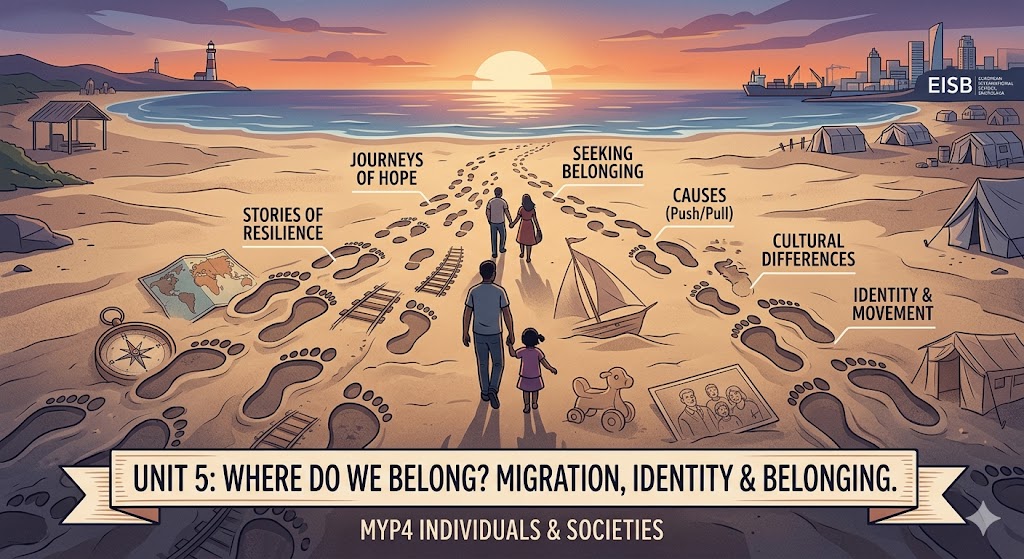
Students are mapping out the classic “push and pull” factors; evaluating how war, economic deprivation, or environmental crises force people from their homelands, while the promise of safety, freedom, and opportunity draws them toward new horizons. Crucially, the unit forces students to confront the profound cultural shifts that occur during these transitions. What happens to a person’s identity when they leave everything familiar behind? How do host nations adapt to influxes of new traditions, languages, and perspectives? By exploring these questions, the class is discovering that migration isn’t just a logistical or legal event; it is a complex negotiation of culture and belonging.
Bringing History to Life: The Summative Exhibition
To demonstrate their mastery of these complex dynamics, the MYP4 students are currently working on a two-part summative assessment that bridges rigorous academic research with creative, empathetic storytelling.
First, each student has selected a real historical or contemporary migration to investigate. They are researching primary and secondary sources to curate a museum-style poster. These visual exhibitions require students to clearly communicate the macro-data: the historical context, the economic impacts, the geographical routes, and the political reactions of the time. The goal is to create a professional, informative display that could stand proudly in any public gallery, educating peers on the structural realities of their chosen event.
But data only tells half the story. To truly understand the concept of belonging, students must step away from the charts and graphs.
The second component of the assessment asks students to write a first-hand, creative account of the migration, adopting the perspective of someone who actually lived through it. Whether writing from the deck of a transatlantic ship in the 19th century, a dust-blown trail during a climate migration, or a modern border crossing, students are using narrative prose to capture the psychological weight of the journey. They are detailing the sights, the sounds, the overwhelming fear of the unknown, and the lingering hope for a better life.
By forcing students to synthesize rigid academic data with deep, narrative empathy, this unit embodies the very core of the EISB philosophy. We aren’t just teaching our MYP4s to understand the global systems that move people across borders; we are encouraging them to recognize the shared humanity within those numbers, preparing them to be the compassionate, analytical leaders tomorrow’s world so desperately needs.