
Animal Signals: How Do They Communicate?
Today, I had the chance to cover for the music teacher in a third-grade class. Since I’m not a musician, I had to improvise, based on the subject I know best: biology. Today there were 19 students in the class. I divided them into five groups, and we got to work.
First, I simply clapped out a very simple rhythm. The students picked it up immediately. I clapped a different rhythm, and they repeated it just as easily. Then I asked how did they know what to do if I did not use words? The students explained that they understood everything from my facial expressions, my gaze, and my body language. It turned out they had picked up on my subtle non-verbal signals.
This led us to the lesson’s topic: A signal carries a message. Communication occurs when another animal receives and understands that signal.
Next, we looked at several examples:
A bird sings to attract a mate or defend its territory.
A meerkat gives an alarm call when danger approaches.
A honeybee performs a dance to show other bees where food is located.
A firefly flashes to attract a mate.
A cat leaves scent marks that convey information to other cats.
A whale uses sounds to communicate over long distances.
For each case, we answered these questions:
What is the signal?
What is the message?
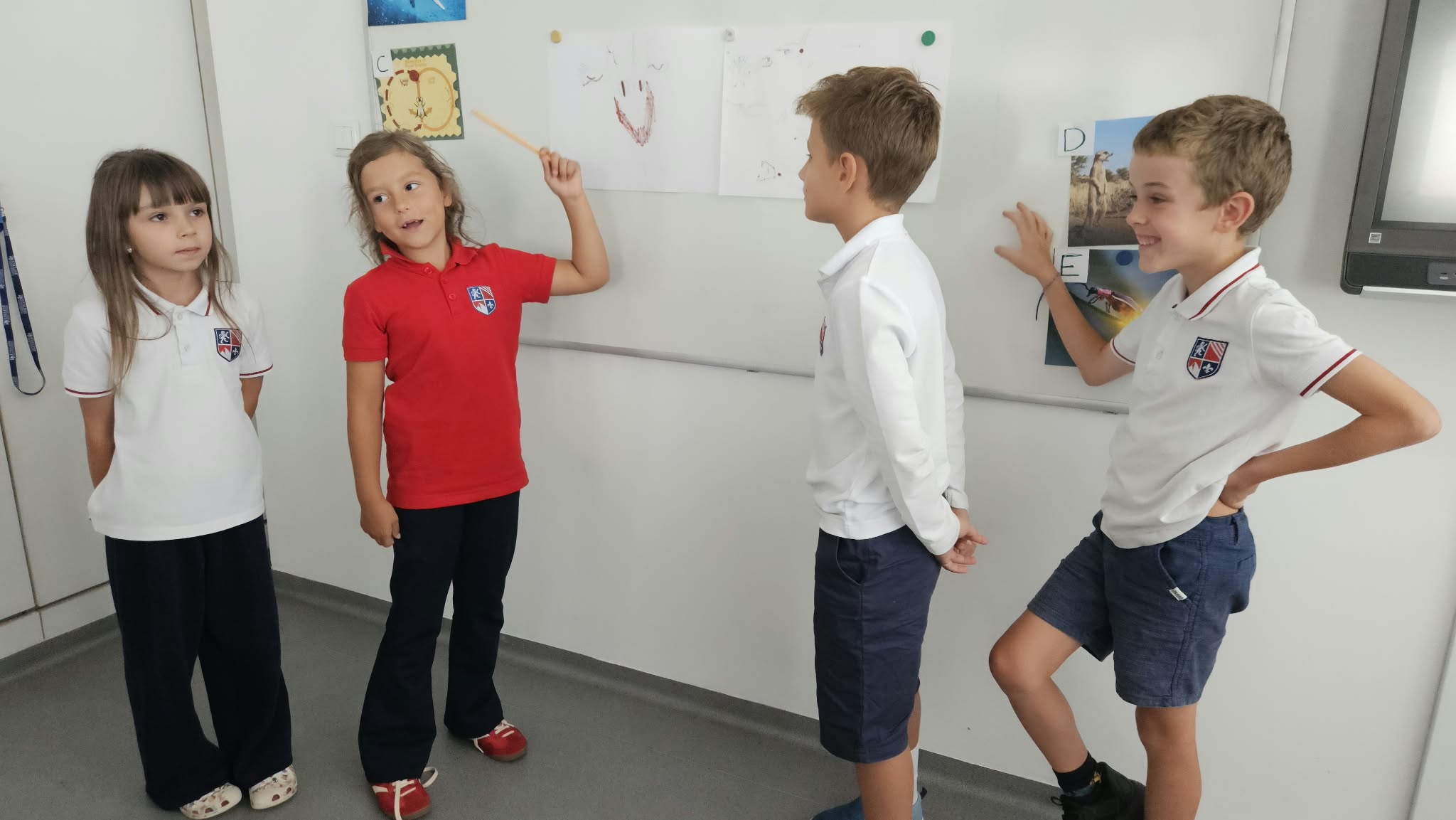
Then, we filled in a chart on the board.

After that, we practiced performing the bee’s “waggle dance,” rubbing our backs against the wall like a bear against a tree, and hissing like angry cats.


Then, the young nature explorers were given a group task:
Each group had to come up with an animal and three signals for it, and explain why those signals were effective in a specific habitat. The habitats were: a dense forest, the ocean, a hot desert, underground tunnels, and a swamp.






After 15 minutes, each group began presenting its invention—an imaginary animal perfectly adapted to its environment that used special signals to communicate.





Thus, through an open class discussion, we explored how animals communicate.