When Disagreement Turns Personal: Lessons from History and Everyday Life
In classrooms, families, and communities today, disagreement is no longer rare—it is expected. What feels new is how quickly disagreement can become personal, relationally costly, and emotionally charged.
Many educators and parents are asking the same quiet questions:
Why do conversations feel so brittle?
Why do people withdraw rather than engage?
Why does moral certainty so often replace curiosity?
These are not abstract concerns. They show up in staff rooms, family dinners, social media feeds, and student interactions. And while the causes are complex, history offers a sobering insight: division rarely begins with hatred. It begins with fear, certainty, and small acts of withdrawal that feel justified at the time.
A Historical Mirror: The Balkans as a Warning
Before the wars of the 1990s, cities like Sarajevo were models of coexistence. Neighbors of different faiths and ethnicities lived side by side. Children played together. Intermarriage was common. Violence was unthinkable.
What changed was not human nature—it was the environment.
Under stress, narratives simplified. People were encouraged to see neighbors less as individuals and more as representatives of a “side.” Silence became safer than speaking up.

Participation in division often began with something as small as repeating a talking point or choosing not to challenge a harmful joke. And with a small nudge the social fabric burst into more than chaos, but civil war in the most brutal sense.
The tragedy of the Balkans reminds us of a difficult truth: ordinary people do not become divided overnight, and they do not need to be cruel to contribute to harm.
The Same Pattern, Closer to Home
While our context is very different, the pattern is recognizable.
Most people do not see themselves as hateful. They care about justice, truth, and protecting what matters. Yet many of us have experienced moments when:
-
We quietly feel satisfied when “the other side” fails
-
We avoid conversations rather than risk discomfort
-
We reduce people to labels instead of listening
-
We excuse contempt because it feels morally justified
None of these moments feel dramatic. That is precisely why they matter.
When disagreement turns into moral certainty about people rather than ideas, something subtle shifts. Curiosity fades. Empathy narrows. Relationships thin out—not because anyone intended harm, but because restraint feels naive and distance feels safer.
Why This Matters in Education
Education is not only about knowledge transfer; it is about formation.
Students are watching how adults handle disagreement. They learn whether complexity is tolerated, whether humility is valued, and whether people are still treated as people when views clash.
In a world that rewards outrage and certainty, schools play a crucial role as spaces where reflection, restraint, and thoughtful engagement can still be modeled. That work begins not by accusing, but by recognizing patterns in ourselves.
An Invitation to Reflect
One helpful question for adults and students alike is not, “Am I right?” but:
“What is this way of thinking doing to my ability to see others clearly?”
Recognition is not condemnation. It is the first step toward healthier dialogue and stronger communities.
For Those Who Want to Go Deeper
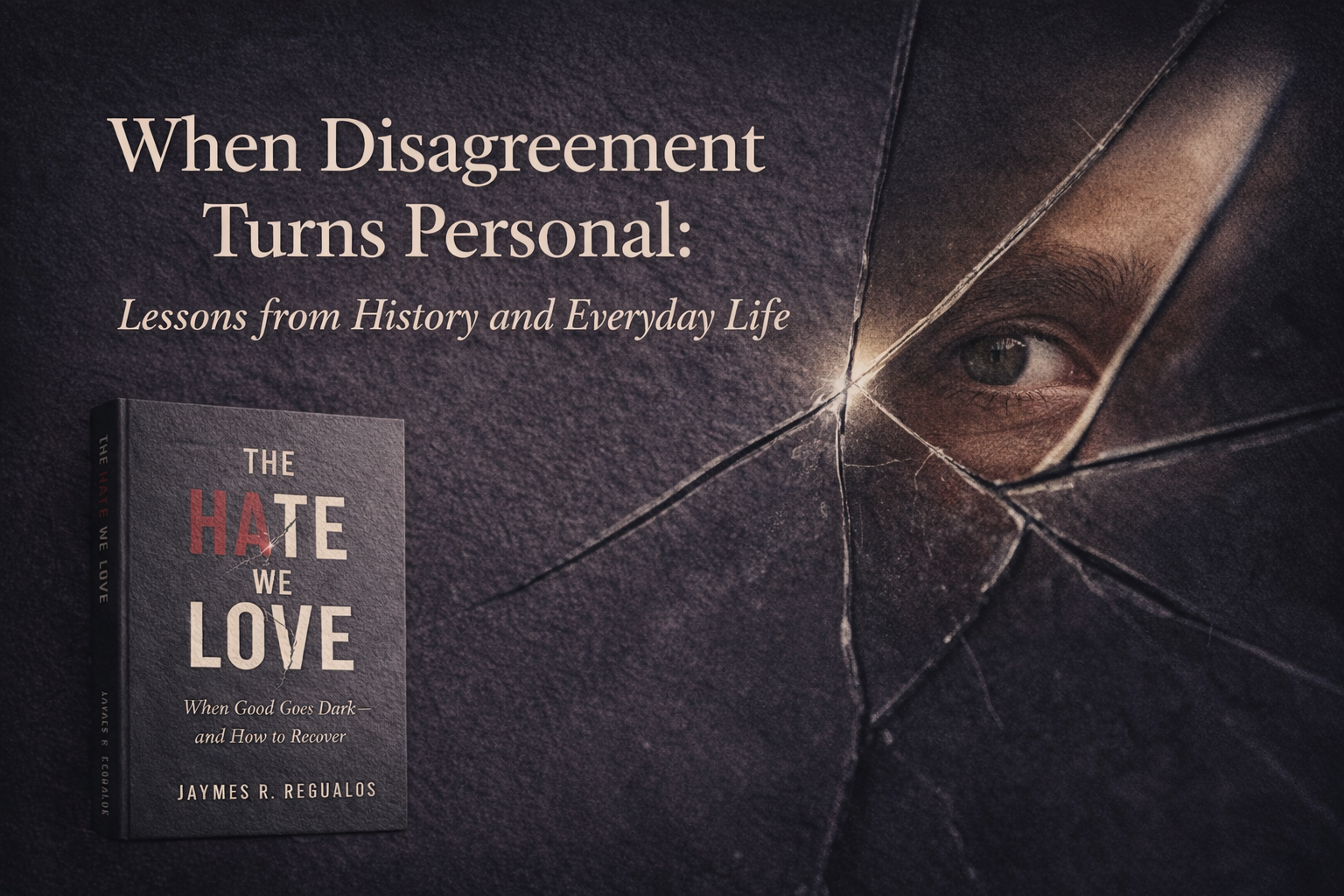
These ideas are explored in greater depth in The Hate We Love: When Good Goes Dark and How to Recover. The book examines how well-intentioned people can gradually participate in cycles of resentment and moral certainty—and, importantly, how those cycles can be interrupted.
The book is built on perspectives of human dignity and is written for anyone who senses that something is off in the way we treat one another and wants practical tools for recovery and renewal.
For families, educators, and older students interested in a deeper exploration, the book is available as an optional resource—not as a prescription, but as an invitation to thoughtful reflection