𝘓𝘢𝘯𝘨𝘶𝘢𝘨𝘦 ᴮ – 𝘚𝘱𝘢𝘯𝘪𝘴𝘩 ˢᴸ – Course overview 25/26
Course Description and Aims
Language Acquisition offers two courses: Language ab initio for beginners and Language B for students with prior knowledge. Both focus on developing communication skills and intercultural awareness so students can use the target language in real situations.
In Language B, students improve their receptive, productive, and interactive skills through five themes: identities, experiences, human ingenuity, social organization, and sharing the planet. At SL, they learn to communicate in familiar and new contexts, while HL also requires the study of two literary works and the use of more advanced language.
Across both courses, students expand vocabulary and grammar, understand how language works, and explore cultural perspectives. The aims are to foster international-mindedness, build communication for various purposes, appreciate diverse viewpoints, connect language and culture, and encourage inquiry, creativity, and critical thinking.
Content outline
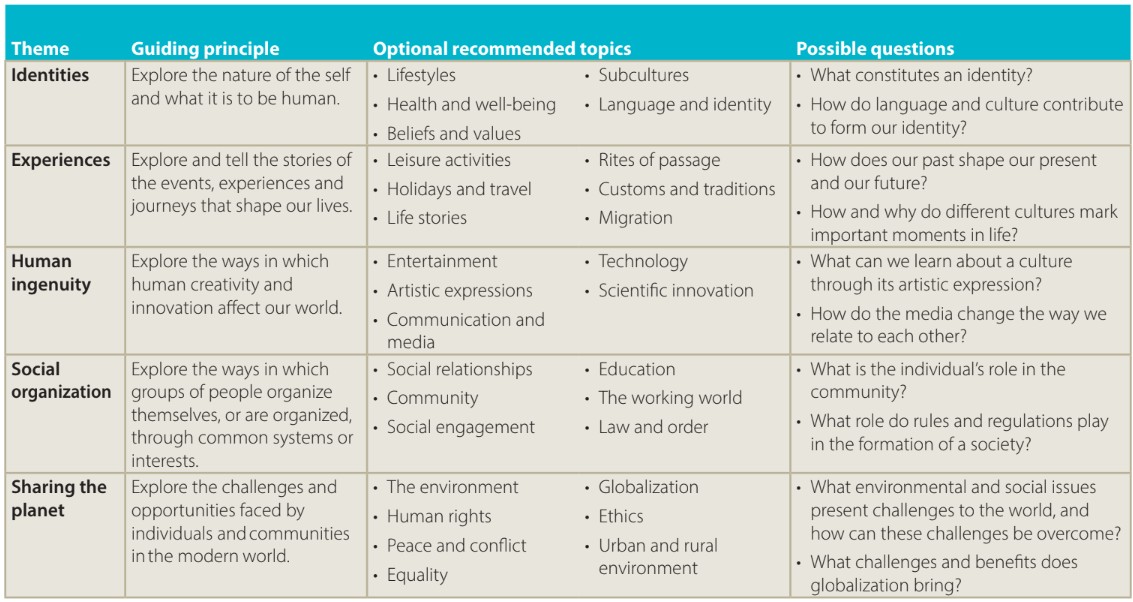
The curriculum is built around five key themes, which students explore through a variety of materials such as written texts, audio, visuals, and multimedia. By working with these resources, students learn to become confident and effective communicators, always thinking about context, audience, purpose, meaning, and style.
Their progress in communication is shown through three main areas: understanding (receptive skills), creating (productive skills), and interaction (interactive skills).
Assessment model
The assessment goals for both Language ab initio and Language B are the same. Students are expected to:
- Communicate clearly and effectively in different situations and for different purposes.
- Use language appropriately with different audiences and in intercultural settings.
- Express and respond to ideas with fluency and accuracy.
- Organize and present ideas on a variety of topics.
- Understand, analyse, and reflect on different types of texts—written, audio, visual, and multimedia.
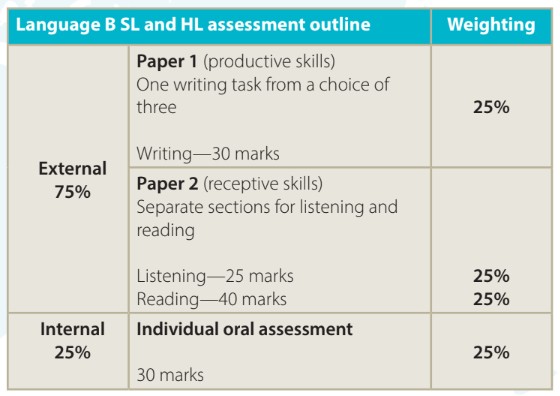
While the assessment structure is the same for Language B SL and HL, the level of challenge is what sets them apart. HL assessments require students to use more complex language, demonstrate higher-level thinking skills, and write longer responses to reflect this depth.
For the individual oral assessment, SL students are given a visual image related to one or more course themes, while HL students respond to an excerpt from one of the two literary works studied.
For further information on the IB Diploma Programme, visit: www.ibo.org/en/programmes/diploma-programme/