The Increasing Importance of IB’s “ATL Skills”
The Increasing Importance of Teaching “ATL Skills”
Nowadays, AI can instantly supply information, write drafts, and generate content for students. For this reason, the value of the IB’s Approaches to Learning (ATL) skills becomes clearer than ever.
A Forbes article from earlier this year made a strong case: The IB ATLs are not simply a “nice add-on,” they are a central framework for preparing students to thrive alongside technology. (Source: Forbes 13.02.2025)
What are the IB ATLs (‘Approaches to Learning’ Skills)
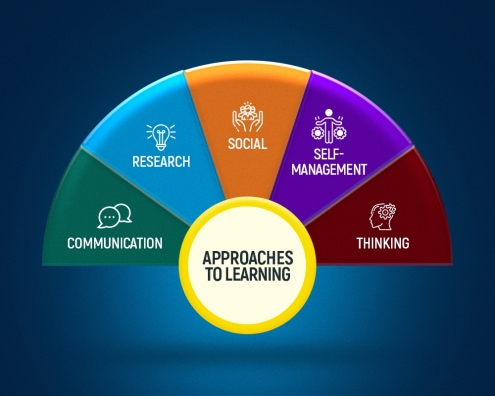
The ATL framework groups essential learning-skills into five broad clusters: thinking, communication, research, self-management, and social skills.
- Thinking skills: critical and creative thinking, metacognition (enabling students to evaluate information rather than just accept it).
- Research skills and information/media literacy: assessing sources, synthesising information (crucial in a world overflowing with data).
- Communication and collaboration: working with others, articulating ideas clearly, engaging responsibly (human-centered skills AI cannot replicate).
- Self-management and social-emotional skills: time management, resilience, self-motivation, empathy (helping learners stay grounded, purposeful, and adaptive).
What This Means for Our School
The ATL skills are more than just a framework mentioned in planning documents. With increasing usage of AI, the ATLs provide a foundation for a more meaningful and more thoughtful form of education. In EISB’s MYP program, teachers aim to:
- Intentionally build and assess ATL skills through tasks that require deep thinking, collaboration, ethical reasoning, and self-regulation (not only content recall).
- Encourage regular reflection: let students ask themselves: How did I do on this task? What did I learn? How did I learn it? Where did this information come from? Can I trust this information? How do I know if I can trust this information?
- Embrace AI as a tool, but keep student reflection, creativity, empathy and ethical responsibility at the core of learning.
Final Thoughts
AI can easily find facts, summarise texts, and write reports. But it can’t think critically, judge ethically, or connect ideas with human insight. The IB ATLs teach students how to learn, how to ask smart questions, how to reflect, how to collaborate, and how to manage themselves. These are skills that go beyond content.
When knowledge is everywhere, what matters is the ability to use it wisely, ethically and creatively. Focusing on the ATL skills helps students to become learners for life (not just passive recipients of information).
As the Forbes article argues, developing the IB Approaches to Learning is not optional: it is essential for students to be able to think for themselves in a world that is increasingly digitalized and AI-based.
Source:
Based on IB’s Approaches To Learning Are Essential For AI Era,” Forbes, February 2025.