
Discovering the Science of Measurement and Uncertainty
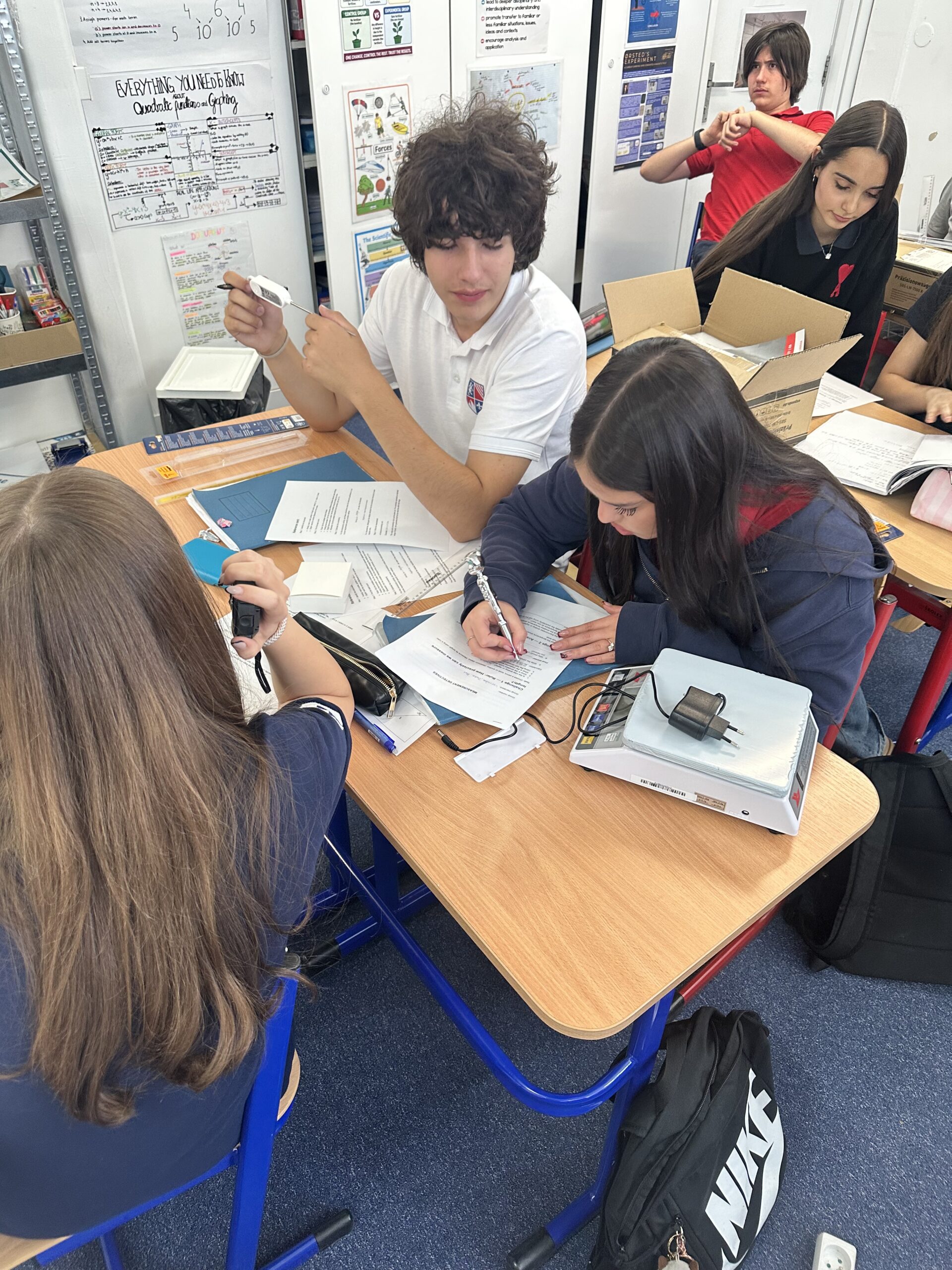
What happens when a simple measuring instrument becomes the starting point for scientific discovery? During a recent Physics lesson, our students explored the fascinating world of measurement and uncertainty through a series of hands-on activities that challenged them to look beyond the numbers and think like real scientists.
The lesson focused on understanding how to determine uncertainties when using different measuring instruments, including both analogue devices, such as rulers and measuring cylinders, and digital instruments, such as electronic balances and digital timers. Rather than simply learning rules from a textbook, students had the opportunity to handle the equipment themselves, take measurements, compare readings, and investigate how the type of instrument influences the precision of a result. They discovered that every measurement has its limitations and that, in science, obtaining a number is only part of the process. Understanding how reliable that number is can be just as important.
One of the most interesting discoveries of the lesson was the students’ experience with analogue instruments. In a world where digital displays provide instant readings, reading a scale marked with small divisions can feel surprisingly unfamiliar. Some students had to pause, look carefully at the markings, identify the smallest division, and consider how confidently they could read the measurement. What might once have seemed like an ordinary task became an engaging challenge, sparking questions, discussions, and plenty of moments of discovery. It was a wonderful reminder that even familiar-looking objects can offer new learning experiences when we begin to examine them through the eyes of a scientist.
As students moved between different instruments, they began to recognise that not all measurements are equally precise. They explored how the resolution of an instrument helps us determine its uncertainty and why digital instruments, despite displaying neat numerical readings, do not provide measurements that are completely free from uncertainty. Through practical comparisons, students developed a deeper appreciation of the care and reasoning required when collecting experimental data. They were not simply following instructions; they were learning to question their results, justify their decisions, and understand the evidence behind the numbers.
Of course, the best part of the lesson was seeing how much learning could happen through doing. Students worked together, shared ideas, checked one another’s readings, and learned from small mistakes along the way. There was curiosity, concentration, discussion, and laughter, all woven into the process of scientific investigation. By turning an abstract concept into a practical experience, the activity helped make uncertainty something students could see, explore, and understand rather than just another formula to memorise.
Understanding measurement uncertainty is an essential skill for any physicist, as every experiment depends on collecting and interpreting data responsibly. These skills will support our students as they progress towards more complex investigations, analyse experimental results, and evaluate the reliability of their conclusions. More importantly, the lesson encouraged them to develop a scientific mindset: to pay attention to detail, question what they observe, recognise limitations, and understand that good science is not about pretending every result is perfect, but about being honest and precise about what the evidence tells us.
Sometimes, the most memorable lessons begin with the simplest questions and the most ordinary pieces of equipment. In this case, rulers, scales, measuring cylinders, and digital instruments became tools for exploration, helping students discover that uncertainty is not something to avoid, but an essential part of understanding the world around us. And if the excitement and curiosity in the classroom were anything to go by, this investigation was a wonderful success. Our students left with more than a better understanding of measurement: they left with a clearer sense of what it means to think, question, and investigate like physicists.
