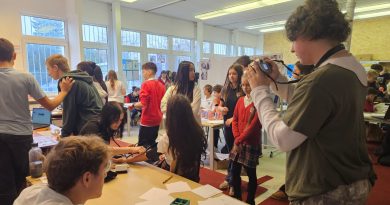
Today, my students practiced a transferable skill by applying it to a difficult global problem

What Can Negotiation Teach Us About Preventing War?
In Global Politics, our students explored a question that has challenged societies for centuries: when countries disagree, how can they prevent conflict from becoming war?
We began by looking at some of the basic building blocks of international relations: borders, countries, territory and competing interests. But rather than stopping at understanding what countries disagree about, we asked students to consider a more practical question:
What skills might help people resolve serious disagreements before they become destructive?
This provided an opportunity to introduce the class to some basic principles of negotiation.
–>Separate the people from the problem
One of the first ideas we explored was the importance of separating the people involved from the problem they are trying to solve.
It is possible to disagree strongly with another person—or another country’s government—without treating that person as the problem.
The challenge is to be soft on the people and hard on the problem: respect the people involved while taking the disagreement itself seriously.
For students, this is a useful distinction well beyond Global Politics. Disagreements happen in classrooms, friendships, families, workplaces and communities. Learning to challenge an idea without attacking the person expressing it is an important communication skill.
–> Focus on interests, not positions
We then considered the difference between a position and an interest.
A position is what someone says they want. An interest is the underlying reason why they want it.
This distinction can change a conversation completely.
Instead of asking only, “What does each side want?”, negotiators can ask:
“Why does each side want it?”
Once we understand the interests behind a position, possibilities that were invisible at first may become available.
For students, this means learning to listen for meaning rather than simply waiting for their turn to respond. It also requires them to ask better questions and to consider perspectives different from their own.
–>Look for mutual gain
Another principle was the idea of inventing options for mutual gain.
Students considered how easily negotiations can become a competition in which one side’s success is automatically seen as the other side’s failure—the idea of a “fixed pie.”
But what if the pie could be made bigger?
This requires creative thinking. Instead of immediately choosing between my solution and your solution, negotiators can ask whether there is another option that addresses important interests on both sides.
That is a powerful shift: from winning an argument to solving a problem.
–>Use objective criteria
Finally, we discussed the importance of using objective criteria.
When people disagree, simply insisting that their own position is correct rarely solves the problem. Negotiations can become more constructive when the participants agree to consider fair, independent or legitimate standards.
This also connects directly to reasoning. Students need to ask:
- What evidence should we consider?
- What would count as fair?
- Which criteria can both sides accept?
- How can we justify a decision rather than simply assert it?
In this way, negotiation becomes much more than persuasion. It becomes a process of listening, questioning, reasoning, evaluating and communicating.
A skill for politics—and for life