Physiology and Psychology in Sports Science
Reaction speed is a process associated with the nervous system that determines the speed of its response to an external stimulus. It is an integral component of speed and agility. Reaction speed is essential not only for staying on slippery ice, catching a falling object, or avoiding an accident, but even in communication—for responding promptly to an interlocutor and quickly making a well-timed joke. When building muscle mass or losing weight, it helps reduce the risk of injury and improve the body’s response to exercise.
Reaction speed in sports is the time elapsed from the appearance of a signal to the onset of a response. A signal can be, for example, an action by an opponent, a teammate, a referee, or a coach, or something happening on the playing field, on the mat, and so on.
For a sprinter or swimmer, it is important to start immediately after the gunshot, whistle, or signal.
In martial arts, it’s choosing the right moment to strike, managing to block, dive or dodge, and counterattack.
For a goalkeeper, it’s predicting the trajectory of a ball or puck and stopping it before the goal line.
In many sports, it’s reaction time that determines performance and the winner.
A signal engages various senses and thus determines the reaction. It can be:
– auditory—the starter’s pistol, the referee’s whistle;
– visual—the flight of a ball, puck, or shuttlecock, the facial expressions of opponents and teammates;
– tactile—a strike, a block.
Reaction speed increases an athlete’s effectiveness in difficult situations. The more well-developed their tactical algorithms and techniques, the better the result.
Reaction speed depends on a number of factors:
– the athlete’s physical fitness and professionalism;
– personal type—extroverts are faster than introverts;
– psychological state—for example, moderate stress can be beneficial, unlike chronic stress;
– time of day – activity may be reduced in the early morning and late evening;
– body temperature – a well-warmed body reacts better;
– number and intensity of stimuli (irritants), and the focus of attention on them;
– use of medications – some medications can cause sluggishness.
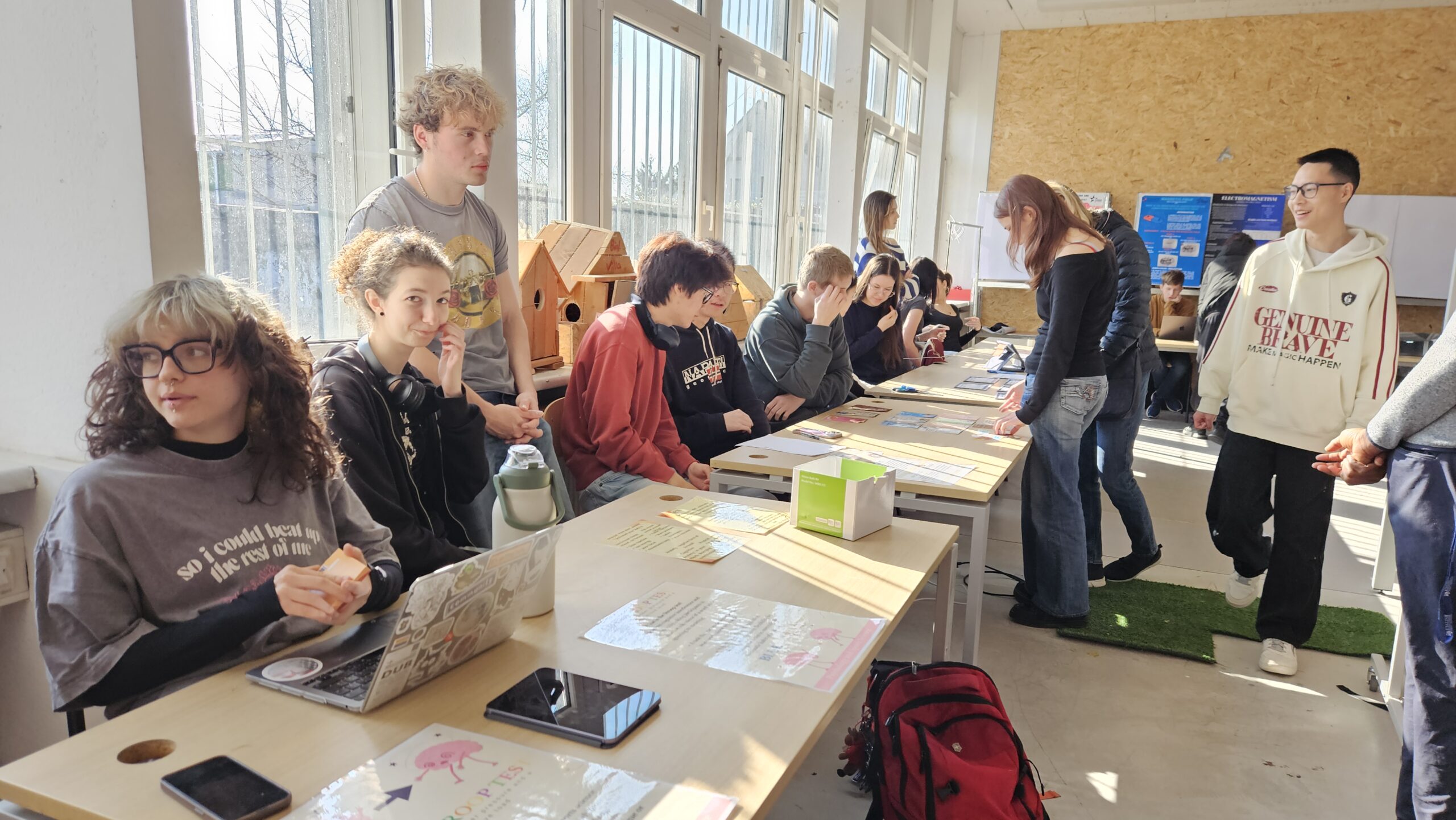
In the SEHS, students spent several classes studying attention, reaction time, and the factors that influence them, particularly how stress affects physiology and performance. The students developed a series of experiments to determine reaction time, attention, and how stress affects task performance, conducted them on themselves, modified them, and presented them at the Open Day in April of this year.


For example, Alexandra and Alfie (Y12) proposed an experiment to test the accuracy of throwing paper balls into a basket within a certain time interval, both while calm and while simultaneously performing another task or when an unexpected auditory distraction occurred.



Yan and Pan (Y12) prepared tasks that involved crossing out specific letters in the test, solving math problems in a calm state, and under psychological pressure.

The Stroop test, developed by Roberta (Y13), generated great interest among the attendees. In this online test, participants had to correctly select cells in which the color matched the written word of a color within a limited time.
If you’re interested in this topic, here are a couple of simple exercises to develop reaction speed.
1. Start by throwing a tennis ball against a wall for 1-2 minutes, perhaps during a warm-up. Once it becomes easy, add a second ball.
2. Hold any object in your hand and extend it out in front of you. Turn your hand so that the palm is facing down. Release your hand and try to catch the object.