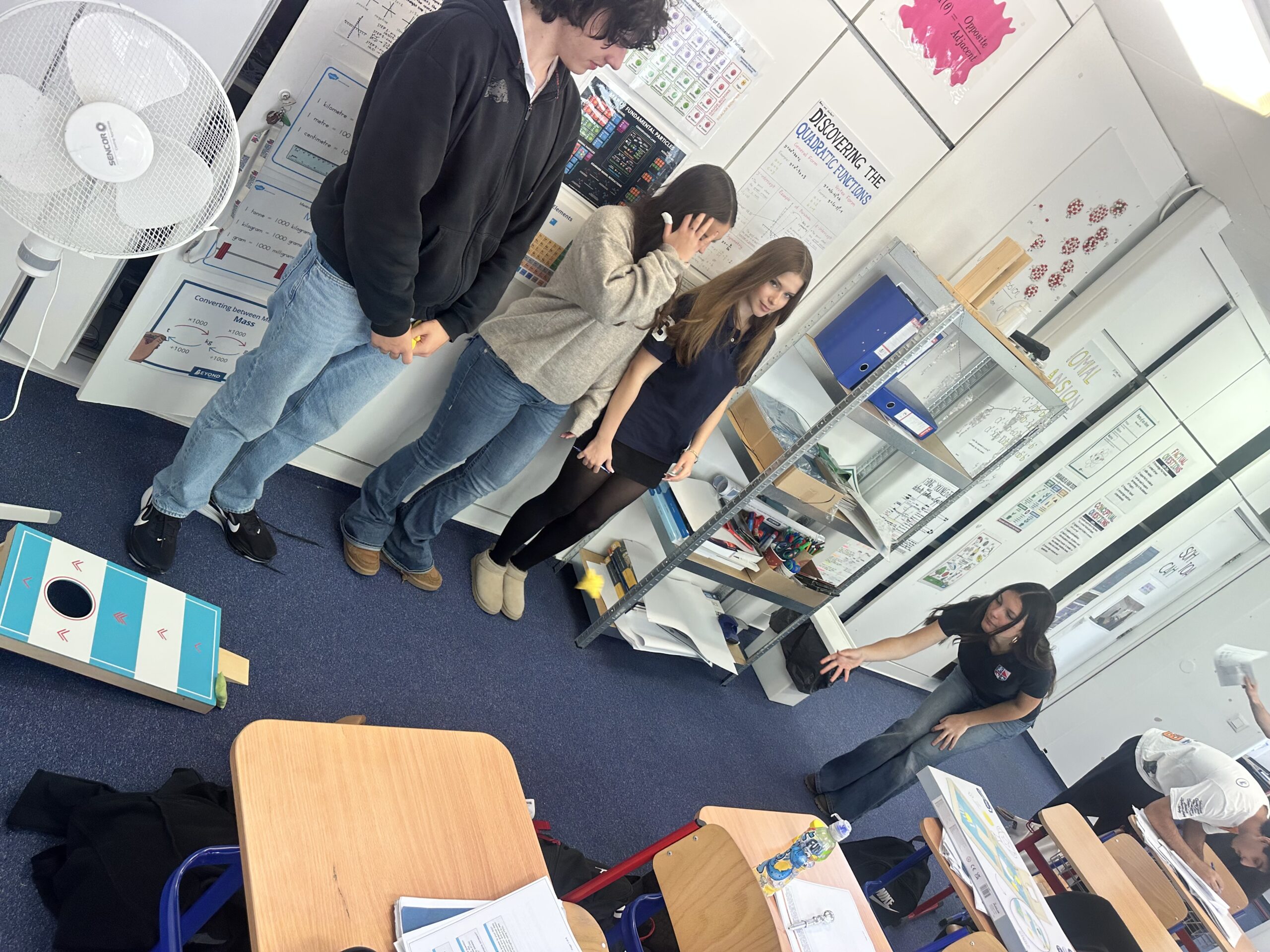
Year 10 and 11 Discover Accuracy and Precision Through Cornhole!
What do a simple game of Cornhole and a Physics laboratory have in common? More than you might think! During one of our recent Physics lessons, Year 10 and Year 11 students discovered that a game of throwing bean bags towards a target could become a fantastic scientific investigation. Through our Cornhole: Accuracy and Precision Lab, students explored two fundamental concepts in experimental physics, discovering that getting close to the target and getting consistent results are not necessarily the same thing.
Accuracy and precision are essential whenever scientists collect measurements and analyse experimental data. Accuracy describes how close a measurement or result is to the accepted or target value, while precision describes how close repeated measurements are to one another. Although these concepts are often introduced through definitions, formulas, and textbook examples, understanding their real significance becomes much easier when students can experience them firsthand. And what better way to explore them than through a little friendly competition?
The investigation challenged students to put their throwing skills to the test. Using the Cornhole game, they took turns throwing bean bags towards a target, recording their results and observing how their attempts were distributed. Every throw became a piece of experimental data! Some students managed to land their bean bags close to the target, while others produced remarkably consistent results, even when their throws were not necessarily close to the ideal position. Through these different outcomes, students could see the distinction between accuracy and precision developing right in front of them.
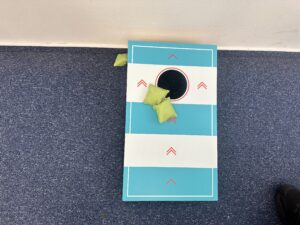
Of course, the classroom was filled with excitement, laughter, encouragement, and a healthy dose of competition. Students enjoyed challenging themselves and their friends, celebrating successful throws, and trying to improve their performance with every attempt. But behind the fun was a very important scientific purpose. They were learning that a single successful result does not necessarily mean an experiment is accurate or precise. To understand the quality of their results, they needed to consider repeated measurements, identify patterns, compare their data, and look carefully at how consistent their observations were.
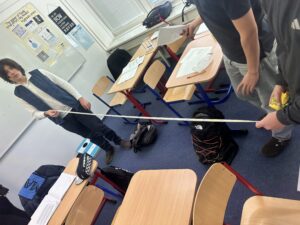
As the activity progressed, students began to connect their experience with the wider world of experimental science. They discussed how measurement devices can introduce uncertainty and contribute to experimental errors, and why scientists must consider both accuracy and precision when evaluating their results. They also discovered that collecting data is only the beginning of an investigation. What really matters is knowing how to interpret that data, recognise patterns, and draw meaningful conclusions from the evidence.
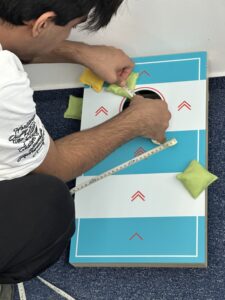
To complete the experience, students put their scientific thinking into practice by preparing a laboratory report. They documented the investigation, organised their results, analysed their data, and explained what their observations revealed about accuracy and precision. This final stage allowed them to move beyond the excitement of the game and demonstrate their understanding through scientific communication. They had to support their conclusions with evidence, reflect on their experimental results, and consider the possible sources of error that could have influenced their performance.
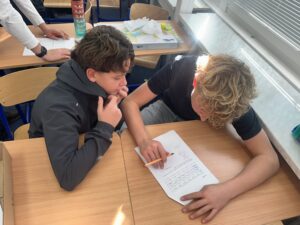
One of the most rewarding aspects of this lesson was seeing how naturally students engaged with scientific ideas when they became part of an experience they could actively participate in. They were not simply memorising two definitions; they were testing them, questioning their results, comparing observations, and discovering the concepts through their own actions. At the same time, they were developing important skills in teamwork, data collection, analysis, and scientific reasoning.
For our Year 10 and Year 11 Physics students, this investigation was a reminder that science does not always require complicated laboratory equipment or sophisticated technology. Sometimes, a few bean bags, a target, and a good scientific question are enough to turn an ordinary classroom into a laboratory full of discovery!
Well done to all our students for their enthusiasm, participation, and excellent work throughout the investigation. We hope they will remember not only the fun they had competing with their friends, but also the important lesson behind every throw: in science, getting the right answer matters, but understanding how reliable that answer is matters just as much.


