
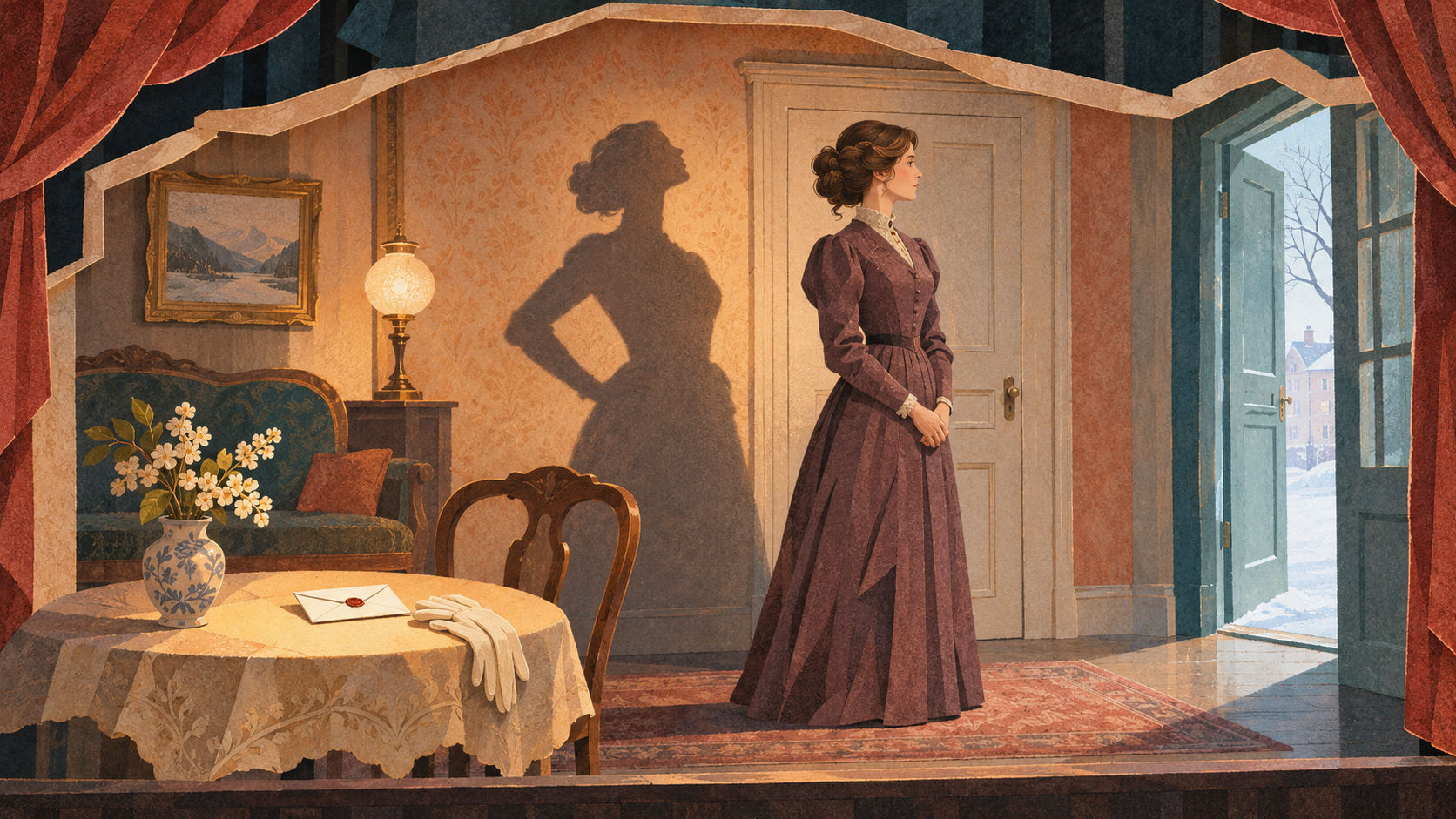
Who are we expected to be? Revisiting A Doll’s House
The home in Henrik Ibsen’s A Doll’s House is also a place where characters manage appearances. Affection, authority, respectability, and dependence are expressed through everyday conversations, making the play a useful starting point for DP2 discussions about public identity and private experience.
One analytical focus is performance: how do people act out the roles expected of them? Nora’s interactions with Torvald invite close attention to the language of marriage. Terms of affection can be examined alongside questions of authority: who defines acceptable behaviour, who controls important decisions, and whose understanding of the relationship carries the most weight?
The tarantella adds a physical dimension to these questions. Nora’s performance invites consideration of spectacle, control, and the distance between what others see and what she experiences. Its significance develops through its place within the unfolding drama, as the audience interprets her actions in light of information that other characters may lack.
Because this is a play, analysis must also attend to stage directions, movement, props, and pacing. A letter or a closed door can organise dramatic tension, while a pause or change in delivery can affect how an exchange is understood. Reading drama involves imagining how these choices might operate before an audience.
The broader question remains relevant: what happens when belonging depends on fulfilling someone else’s expectations? Ibsen’s domestic setting allows students to examine how social values are maintained through intimate relationships and ordinary habits.
The play also creates room for disagreement. Readers may interpret Nora’s conduct differently, and those differences become productive when supported by precise evidence. The educational value lies in learning to develop a defensible interpretation, consider alternatives, and explain why a particular dramatic choice matters.